We bridge cultures
Pont Neuf Paris
Pont Neuf, Paris
Japanese Gardens
Japanese Gardens, Pasadena
Montserrat Barcelona
en route Montserrat - Barcelona
Tower Bridge London
Tower Bridge, London
script>
Skip to content

Tina Kover – linguist of the month of July 2019


The Albertine Prize is awarded each year in New York for the best English-language translation of a work of fiction written in French. The winners of the Prize for 2019 are Negar Djavadi, the author of
D
ésorientale,  and the translator, Tina Kover.  Tina's translation, Disoriental,  was published by Europa Editions (May 1, 2018).

Négar Djavadi was born in Iran in 1969 to a family of intellectuals opposed to the regimes of the Shah, then to that of Khomeini. She arrived in France at the age of eleven, having crossed the mountains of Kurdistan on horseback with her mother and sister. Djavadi is a screenwriter and lives in Paris.


Albertine Desorientale + Djavadi

The Prize was awarded on June 5, 2019, at a ceremony at the Albertine Bookstore, in the presence of the author and the translator, as well as Lydia Davis and the French TV presenter and literary critic, François Busnel.

Albertine 4 participants

Négar Djavadi et Tina Kover,
at center

To watch the discussion (1 hour 18 minutes) that followed the ceremony, see https://bit.ly/32AYHNq.

The name of the Albertine Prize and of the bookstore of that name where it is awarded every year, is located on Fifth Avenue, New York, in a building belonging to the French Government in which the Cultural Services of the Embassy of France are housed. It is also the name of one of the characters in Marcel Proust’s “In Search of Lost Time (À la recherche du temps perdu), Albertine Simonet, the lover of the narrator Marcel. Albertine appears in several of the seven volumes of Proust’s work, such as In the Shadow of Young Girls in Flower (À l'ombre des jeunes filles en fleurs), Sodom and Gomorrah (Sodome et Gomorrhe) and The Prisoner (La Prisonnière).

Tina Albertine Prize J.T.Mahany cropped
Tina Kover
The interviewee
  J.T. Mahany
The Interviewer

Tina Kover has been a literary translator for nearly twenty years, translating works of both classic and modern literature including Alexandre Dumas’s Georges, the Goncourt brothers’ Manette Salomon, and Anna Gavalda's Life, Only Better. She studied French at the University of Denver and the University of Lausanne, Switzerland, and later worked in Prague teaching English as a foreign language. She currently lives and works in the northeast of England. Her translation of Négar Djavadi’s Disoriental was a finalist for the National Book Award for Translated Literature in 2018 and the PEN Translation Prize in 2019, before recently winning the Albertine Prize.

J.T. Mahanay is a translator of French literature. He received his Master of Fine Arts in creative writing from the University of Arkansas in 2018. In 2015, he translated Antoine Volodine's Post-Exoticism in Ten Lessons, Lesson Eleven. His translation of Bardo or not Bardo, also by Volodine, was awarded the debut Albertine Prize in 2017. 2020 will see the publication of his translation of Onze rêves de suie (Eleven Sooty Dreams) by Manuela Draeger. He is also an amateur teuthologist. 


E X C L U S I V E   I N T E R V I E W 

J. T. Mahany: The Albertine Prize is now the latest in a long parade of accolades that Disoriental has obtained. What is it about Djavadi's book you feel that has drawn so much acclaim (both in its original French and your translation)?

Tina Kover: I think there are several factors. Of course the writing itself is exquisite, and Négar Djavadi is a brilliant storyteller with a rare ability to make each reader feel as if she’s speaking directly to them. The book also touches on a number of issues that are of the utmost timeliness at the present moment: immigration (and refugee emigration), bigotry, sexual identity, acceptance. There is something in Disoriental for everyone; some intimate moment or observation that feels deeply personal no matter what you might be struggling with. This is a book that reaches across many lines and crosses multiple boundaries and I think that’s why people respond to it in any language.


J. T. Mahany: What was the process of translating the book like? Did you collaborate with Djavadi at all on the text? Did it differ much from the way you have translated the rest of your (rather prodigious, I may add) bibliography?

Tina Kover The process in itself was pretty much my standard one; I never read a book before I begin translating it and so I’m discovering the characters and the plot as both a reader and a translator, which, for me, at least, I think is key to retaining freshness and spontaneity in the finished work. Likewise, it’s not my general practice to communicate with authors during the translation process. They’ve created the original text in the solitude of their own minds and I prefer to do the same thing, though of course I welcome their input during the editing phase. I will say that from very early on I knew that Disoriental was something very special, the kind of novel that doesn’t come along very often, and I felt what I can only describe as a sort of reverence for its beauty as I got deeper into the story and realized what Négar was crafting and how ingeniously she was doing it.

  Albertine poster  
  “An extraordinary novel, both in incident and telling.”
Rivka Galchen
 

J. T. Mahany: A review of Disorientalin in The Thread compares Djavadi's work to that of Elena Ferrante. Do you agree with this comparison?

Tina Kover: I’m certainly no expert on Ferrante, but I can see why people might make that comparison. I think Danny Caine said it very well in the review you mentioned: both Négar and Elena Ferrante are incredibly adept at creating brave and fully-realized female characters, and both are able to draw intimate portraits set within a context of broader-ranging social and political climates. I think it says a great deal for the wisdom of the editors at Europa Editions, who published both authors, that they saw how important these books could be and how much people would take them to their hearts.


J. T. Mahany: Disoriental concerns itself with a narrator who feels as though she is caught between two worlds, a theme which has appeared in the works of a number of authors writing in French, such as Dany Laferrière and Akira Mizubayashi. What is it about this type of narrative that you believe is appealing to readers?

Tina Kover: Most of us, if not all, feel caught between two worlds at some point in our lives, whether physically, emotionally, or culturally. As an expatriate myself there is a great deal in Disoriental that struck a personal chord with me even though my own experience of leaving one country and settling in another was different in almost every particular. But people might also feel like they inhabit a different “world” because of sexuality or race or disability or any number of things. At bottom I think that “caught” feeling is about alienation, about feeling like one doesn’t belong, and that’s something we can all identify with.


J. T. Mahany: How did you first get into translation?

Tina Kover: I actually self-published my first translation, George Sand’s The Black City, which was then taken on by a wonderful literary agent, Sandra Choron, and subsequently purchased by the now-defunct Carroll & Graf. Things progressed from there. I’ve been very fortunate to come into contact with a lot of incredible people in the publishing world and to have had the opportunities I’ve had, and I feel especially privileged to be a translator right now, when literary translation is receiving so much interest and attention, and when it’s more important than ever to keep the lines of communication open between cultures, to promote intercultural exchange and understanding when so many seem bent on their destruction.


J. T. Mahany: Do you have any upcoming projects about which you'd like to speak?

Tina Kover: I’m extremely excited about the upcoming release of my translation of Mahir Guven’s Older Brother, which will be out from Europa Editions on October 8th. The book won the Goncourt Prize for a debut novel in 2018 and it’s another timely and extremely powerful depiction of life on modern society’s fringes, another story we all need to hear right now.

Additional reading:

Author Negar Djavadi Awarded 2019 Albertine Award for Her Debut Novel "Disoriental"
L'Officiel, June 7, 2019

A Persian Turned Parisian Insists: I'm Not an Immigrant, I'm an Exile
The New York Times, January 8, 2019


Carmella Abramowitz Moreau – linguist of the month of February 2019

AN INTERVIEW TO BE SAVOURED

Andrea profile Carmella  cropped

             Andrea Bernstein
             - the interviewer

Carmella Abramowitz Moreau
– the interviewee

This month our guest, Carmella Abramowitz Moreau, is a translator specializing in culinary translations from French, and living with her family in the 3rd arrondisement of Paris. The interview that follows was conducted by Andrea Bernstein, the spouse and personal chef of your faithful blogger. Andrea, like Carmella, was born in South Africa, where she obtained her doctorate in social work and was Professor of Social Work and Department Head at the University of Natal. After immigrating to the United States and working as an editor of academic texts, Andrea launched a new career as a consultant in the field of leadership development and was involved in the training of senior executives of major American companies. Both Carmella and Andrea are passionate about food and cooking. [1]

———————

Andrea Bernstein:  You grew up in South Africa, where many languages are spoken, (eleven of which are now designated as official languages) but where there was no French influence, unless you count the arrival of the Huguenots at the end of the 17th century. Despite Sorbonnethat, you gravitated to the French language, and to everything French, initially by moving to Montreal, at the age of 23, then to France where you completed the Diplôme de Civilisation française at the Sorbonne. You then went on to obtain a diploma in French-English translation, followed by a Masters in the same area. You married a Frenchman, and have lived for 35 years in Paris, where your children were born.  What stimulated your interest in learning French and in becoming sufficiently fluent to become a translator?  

Carmella Abramowitz Moreau: I completed my first degree at the University of the Witwatersrand in South Africa in Social Anthropology and English literature. My main regret regarding this degree is that I studied Zulu for only one year. My father was gifted in languages and read many alphabets. I think he helped instill in me my linguistic curiosity. As a child, I briefly took French lessons with a wonderful teacher but in high school I had to choose between French and Latin and I opted for Latin. My real attachment to, and love of, French began after my first degree, when I started studying French largely on a whim, taking intensive courses at language schools in both Lausanne and Paris, before going to Montreal where I completed a graduate diploma in language teaching. A year at the Sorbonne, also intensive, helped me on the path to fluency. Choosing to settle in a country seems to demand that one at least aspire to fluency. I was lucky to have always benefitted from excellent language and linguistics teachers.


AB: When I look at the list of your translations, it seems you have specialized in art, music and cooking (with some diversions into urbanism, microfinance, science and ethnomedicine). Let’s concentrate on culinary translation for the purposes of this interview. How did you get started in the field?

CAM: Carmella with pavlova My first cookbook translation fell into my lap after someone with whom I had studied translation recommended me to a publisher, knowing that I love cooking and baking, and that I had previously taken courses. One thing led to another, as tends to happen. Some time previously, I had taken weekly pastry-making lessons for a few years with a marvelous pastry chef, also a remarkable teacher. He demystified many aspects of classic French pastry-making for me. Although I don’t necessarily make this sort of thing any more, I can quite easily explain how to make Italian meringue. I can tell if there’s a serious typo in a recipe quantity, or an important ingredient inadvertently omitted, and so on. Since then, I’ve also taken short Viennoiseries courses in Viennoiseries and bread-making. But the task of explaining how to fold and roll out puff pastry never gets any easier – I suppose this is the case for any kind of a technical translation. Living in Paris certainly makes it easier to keep up with cooking trends, for example neo-bistro cuisine.


AB:  Personally I love reading cookbooks (even if I don’t make most of the recipes). What are some of the special challenges you’ve encountered in translating recipes?

CAM: The most challenging is translating complicated recipes by well-known chefs that are included in books targeted at the general public. They contain ingredients that are often not readily available even here in France, such as the latest vegetable or citrus fruit that they have an exclusive supply line for, a rare breed of meat, a rare species of fish, etc. I have to convey to the home cook how best to reproduce the recipe. Then there are the instructions that are incomplete or fiddly — recipes that top chefs use in their kitchens where sous-chefs are there to weigh out 43 grams of this and 127 grams of that. Meat cuts also differ from one country to another, even among English-speaking countries (and are far more intricate in France), as do weights of what constitutes egg sizes – an EU medium egg is more or less equivalent to a large US or Canadian egg, and Australia and New Zealand are different again. Added to the egg size difficulty is the French chef’s penchant for weighing yolks and whites – 75 g of egg white converts to about one-third of a cup, but who outside a professional kitchen likes to divvy up eggs? Percentages of butterfat in cream are not specified in certain countries but one needs to know what to use, Carmella ganachefor example, to make whipped cream or a certain type of ganache. Then there are the chefs who use idiosyncratic or regional terms for the preparation of part of a chicken or a common vegetable. At times, I resort to consulting my butcher or greengrocer. I long for the day when the US will switch to the metric system and kitchen scales become more widespread there, so conversions to the imperial system will no longer be necessary.


AB: How do you deal with the issue of a technical vocabulary? I believe there are often no exact equivalents for French terms.

CAM: I’m frequently asked if this poses a problem. It’s true that often there is no exact word for specific actions, and that French is very rich in technical culinary vocabulary. It’s generally quite easy to explain what has to be done in a few short, explicit phrases. Chiqueter, for example, a word I learned at pastry lessons, is the action involving scoring the edge of two layers of puff pastry to seal them together using the back of a small kitchen knife. And if you were wondering, yes, it tends to be recommended when making galettes des rois. I like to add the French word so that the reader becomes familiar with it.

Carmella SALT FATChanges in language as the world becomes increasingly foodier also need to be taken into account. The other day, I watched the series “Salt Fat Acid Heat”, in which Samin Nosrat made citrus suprêmes. For the moment I’m still sticking to “sections”, but I should think that soon all English speakers will happily be decorating tarts or cake tops with “orange supremes”. (Chicken breasts are another matter.) We have to juggle with the level of readers’ sophistication and how far foodie vocabulary has spread or will have spread by the time the book is published.


AB: Carmella repas-gastronomiqueGastronomy is part and parcel of French culture, as testified by the French gastronomic meal being included in the UNESCO list of world intangible heritage. Sitting down to enjoy a meal, whether gastronomic or not, is an integral part of the way of life. Is there any reflection of this facet in recipe books?

CAM: I feel I should preface my answer by saying that I see my task as twofold. Producing a book that will not only sell outside of France but can be used by the people who buy it, and making it as user-friendly as possible, while retaining the French touch in spirit. I don’t feel that making the necessary adaptations is a betrayal in any way, so long as I can remain true to the recipe. Having said that, there is a significant difference in the French and Anglo approaches to recipe writing. An English-language recipe will take the cook by the hand, so to speak, and guide him or her through each step (of course, depending on the target readership’s level of cooking). It will give pan sizes, cooking or baking temperature, an indication of doneness at each stage, the speed for the stand mixer and the length of time to beat at that particular speed. Many a French recipe, translated word for word into English, would look terse, or even unfeasible. Pan size? Oh, just use whatever you have. Indications of doneness? We’ve given you the cooking time – surely that’s enough! Storage instructions? But they go without saying. I suspect that the underlying reason is an assumption that the user of the cookbook will have cooked with a family member during childhood, or spent considerable time watching someone cook full meals, or know what the end result should be. In other words, a great deal of previous knowledge tends to be assumed, so I think that this is where the heritage comes in.

Ingredients have to be listed in order of use – a common recommendation in most English-language cookbook style guides, but not necessarily followed in France. If there is an instruction at the end of the recipe telling the cook to stir in the raisins that have been soaking
Carmella crepes-chandeleurin rum for 24 hours, I’ll start the recipe with an instruction to soak them 24 hours ahead. Here is an example I saw only yesterday: Now that we have transitioned from galette des rois season to la Chandeleur and crepes are everywhere, celebrity chef Thierry Marx published an online recipe for a crepe cake. One of the instructions is « Ajouter le lait préalablement porté à ébullition ». After so many years in France, I still find this discombobulating. As someone who cooks quite a lot, I transform it according to logical English-language order. Useful advice, though, is often a thorny issue, as notes generally appear at the end of the recipe in French – too late for some! If possible, I incorporate them as relevantly as possible, but layout does not always permit it.

Photos, too, may be problematic: English-speakers expect the end result to resemble the photo, but French books may provide an “artistic interpretation.” A recipe for a large cake may show several individual portions or be decorated with unspecified ingredients. In cases like this I find myself resorting to what a fellow translator told me is known as “creative insubordination”.


AB: You once told me that cultural issues crop up in the most unexpected ways. Please give us some examples of these.

CAM: Well, one needs to be au fait with all sorts of issues.  A chef who provided a recipe in a book I translated recently advised his readers to use only Iranian pistachios, for, in his opinion, nowhere else are such fine quality nuts produced. I don’t know how well this would go down in a country with a ban on many products from Iran, not to mention the fact that California is also a major pistachio producer.
Carmella lobstersThe solution is to find something a little neutral and bland (no pun intended) to say instead. Preparing live lobsters was an issue that triggered a long discussion with the translator with whom I was sharing a project. After research showing that crustaceans feel pain, Switzerland passed a law outlawing the boiling of live lobsters. How long will it be before other countries implement similar legislation? We do try to keep in mind the shelf life (again, no pun intended) of the recipes. Awareness of sustainability may not be as pronounced here as in the countries where the book is to be sold, so for seafood, for example, we may add a note advising the cook to check that certain fish, eels, or whatever, may be used responsibly.

Carmella community gardenPre-#MeToo, I gave a workshop to students working on the translation of a compilation of recipes from community gardens in Paris. A recipe for nettle soup was preceded by a short text on the long legs of a gardener wearing an attractive mini skirt. I asked the class what their reactions were. After some thought, the mainly women students said they found it perfectly acceptable, and a good reflection of the French way of life. The book was to be marketed to tourists in Paris and community gardens in large US cities. The dual-nationality American professor, who hadn’t really noticed this previously, was outraged and said, “Censor it!” I think it was her opinion that ultimately prevailed. 


AB: How do you deal with dishes that are well-known in France but possibly unknown to English-speaking readers?


When I have to translate a recipe for a little-known regional specialty, I usually ask if I can include a short history or explanation of the dish. I enjoy the extra research and if there is room, certain editors are happy to have a little bonus.

Carmella macaron-v-macaroonAgain, as the world becomes more and more foody, fewer explanations will become necessary. Some ten or fifteen years ago, we would have to explain that macarons are not the same as macaroons! Now, macaron doesn’t even require italics. Kouign amman seems to have emigrated from its native Brittany and hit the US, or at least parts of it.

Amusingly, I sometimes also have to deal with the reverse phenomenon. French chefs like to “frenchify” typically Anglo-Saxon recipes. I’m thinking of apple pie and cheesecake in particular, which they often explain to their French readers. The texts for these usually need complete rewriting and so I’ll draft a suggestion for the editor. It’s an opportunity for me to add a little culinary history or fun fact, though not every editor is receptive to this type of adaptation.


[1]

Carmella bookshelf Andrea bookshelf rotated
Carmella's bookshelf of cook books Andrea's bookshelf of cook books

Blog Editor's note: British spelling has been used in this interview.

Anne Trager, linguist of the month of November


Our guest linguist this month is an American, a Francophile, a literary translator, and the founder of Le French BookThis New York-based publishing house is dedicated to selecting, translating and publishing contemporary mysteries and thrillers from France, so as to bring them to readers across the English-speaking world. Anne lived in Paris for many years and now lives in Pibrac, a small town 15 kilometers west of Toulouse.


Anne banner

Website: www.LeFrenchBook.com


 LMJ : What is your background?

I grew up between Ohio and the southwest of the US and for as long as I can remember I dreamed about traveling overseas. Maybe it's because my parents were linguists, or maybe it's because they spelled my first names à la française: Anne, with an e, and Valerie, with ie. When I was a teenager, I was reading Gourmet Magazine religiously and experimenting with Mastering the Art of French Cooking (by Julia Child). At the time, the best place to learn to make really good food was Paris. So, I studied French and went to Paris as soon as I could. I trained as a chef and continued to study French (and a little Chinese). It didn't take me long to begin translating and interpreting. Later, I worked in publishing in France, doing project management, and I did a long stint in corporate communications. As far as translation is concerned, I always considered myself a generalist, and I translated anything and everything I could get my hands on. Translating fiction is different from other kinds of translation. Every book is an adventure in and of itself. This kind of translation is rooted in something deeper and broader than foreign rights acquisitions and the mechanics of getting a work from one language into another—it's about building bridges between cultures. It is very important for me to build a relationship with an author. Translation is like getting into the author's head; I think it's polite to knock first. I also believe in relationships when it comes to editors and other translators. For a book to work, you need to give it everything you've got in translation, in editorial, and in marketing. That's what we are trying to do with Le French Book.


LMJ :What led to the creation of Le French Book?

Le French Book

What if you could discover France while reading French crime fiction in English? This simple question sums up the whole project behind Le French Book and probably also my vision of life as an American living in France for so many years. I always loved mysteries and thrillers and, I must admit, this is almost the only genre I read. When I discovered French crime fiction novels, I was amazed by the richness and creativity of a great number of French authors. So I read, I read, I read. Then, I realized that only very few of these books were available in English and the idea dawned on me: these books need a greater audience and I must help English-language readers to discover them. So, I put together a team, including co-conspirator Fabrice Neuman, aka The French Connection; Amy "Red-line" Richards, translation editor sometimes known as The Slasher; and Jeroen "Bleeding in the Gutter" ten Berge, cover artist. My co-translators include Julie Rose, Jeffrey Zuckerman, Sophie Weiner and Sally Pane.

Anne TragerAnne Trager


    Julie Rose       Jeffrey Zuckerman


                                Sophie Weiner          Sally Pane


LMJ : How do you choose the titles you translate?

I spend a lot of time reading, and getting everyone I know in France to tell me what their favorite books are. I attend book fairs and talk to the authors. But the choice comes down to feeling. Our motto is, 'If we love it, we translate it.' Le French Book is about sharing reading pleasure. For now, we only publish mysteries and thrillers published in France by French authors. We keep an eye out for titles that will have something American readers can relate to. For example, we are translating the series known in France as Le Sang de la Vigne, by Jean-Pierre Alaux and Noël Balen, which we call the Winemaker Detective series. This works well because of the very strong link in people's minds between France and fine wine. We also are publishing the Paris Homicide series by Frédérique Molay, who won the Prix du Quai des Orfèvres with the first title The 7th Woman. In this series, the city of Paris is a character. We also look for titles that strike us as particularly interesting for whatever reason. White Leopard by Laurent Guillaume is set in Mali. The Greenland Breach and The Rare Earth Exchange, a climate thriller and a financial thriller respectively, are by Bernard Besson, a former top-level spy who is spot on when it comes to espionage and what is at stake in geopolitics today. David Khara's Consortium series makes a strong connection to WWII and today's scientific research and transhumanism. The Paris Lawyer by Sylvie Granotier has rolling countryside, hidden secrets and a quest for the truth. The Collector by Anne-Laure Thiéblemont has the merciless microcosm of Paris art galleries. And the Antoine Marcas series by Eric Giacometti and Jacque Ravenne gives an action-packed look into Freemasons, aside from having sold 2 million copies worldwide.

To sum up, we look for great stories, with that additional je ne sais quoi that makes us all dream about Paris or France, along with pace and suspense and good writing.


Treachery in Bordeaux cover     The Collector cover     Freemasons, gold, conspiracies, and freedom
             1                               2                                 3

1. Mission à Haut-Brion, Jean-Pierre Alaux & Noël Balen;
    Librairie Arthème Fayard,
2. Le Collectionneur,  Anne-Laure Thiéblemont, Editions Liana Levi, Paris
3. Le Frère de sang, Eric Giacometti & Jacques Ravenne, Fleuve Noir, Paris

LMJ : Do you think crime fiction sanitizes crime?

I think that good fiction changes the way we perceive the world, it shifts our awareness, at least for the period of time we are reading the book. I would say that crime fiction is one way to process and deal with senseless violence that is all around us. It's a little off topic, but I'm reminded of something one of our authors said. David Khara said, "The idea for The Bleiberg Project came to me after listening to a woman who survived the death camps. Three things struck me. The first was her sharp sense of humor. She said that prisoners inside the camp made jokes whenever they could. Humanity cannot be destroyed as long as laughter is possible. It becomes an act of resistance. The second thing was her will to survive, no matter the obstacles, no matter the horrors. And finally, she was living proof that to remember and understand History is the best, and maybe the only way, to avoid repeating our mistakes."


LMJ : What does the future hold for Le French Book?

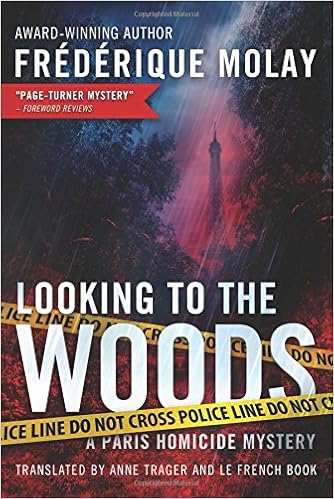
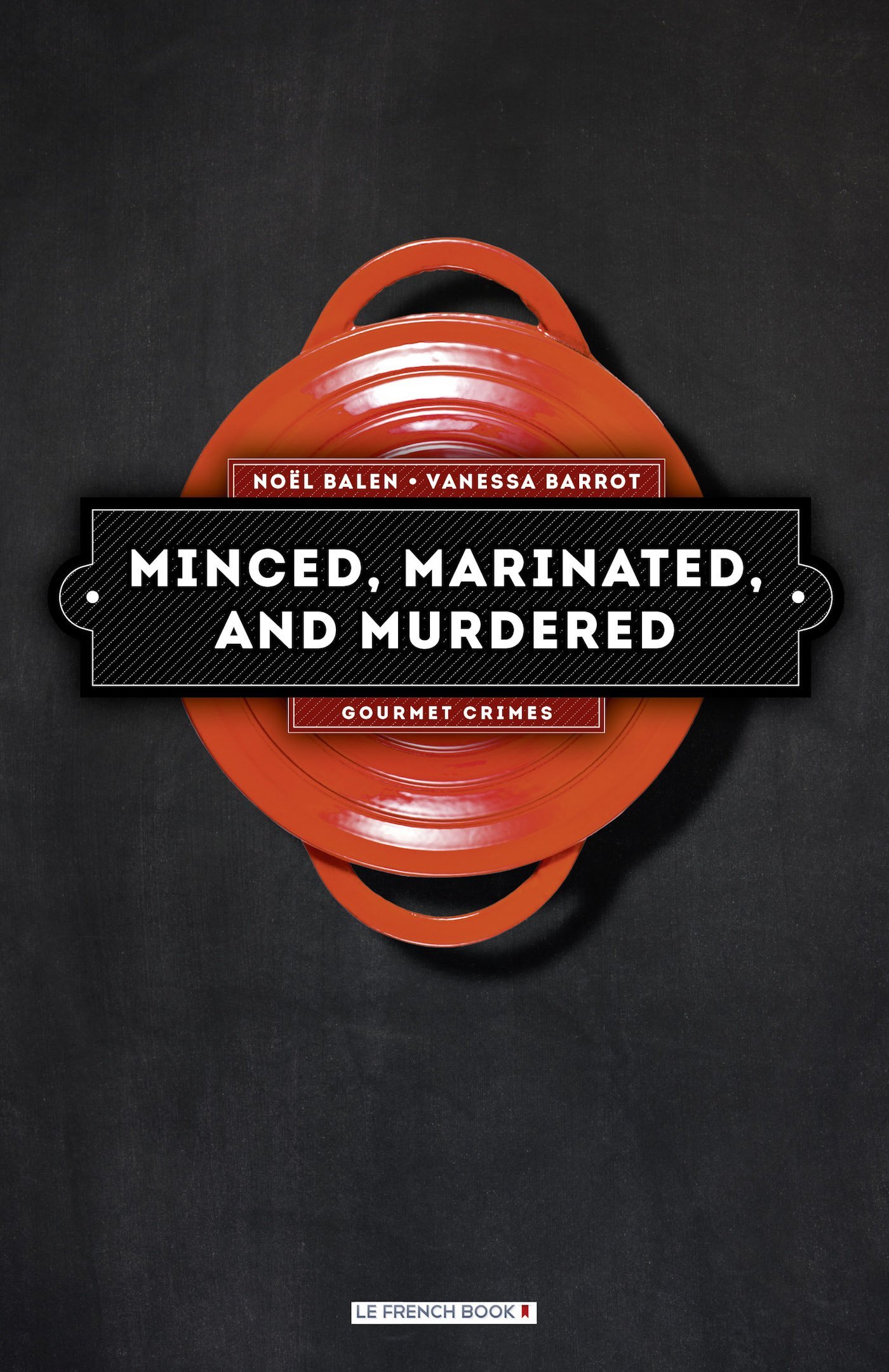
We want to keep publishing entertaining books, serving as a bridge between creative contemporary France and the English-speaking world. We also want Le French Book to become the synonym for great books in the mind of readers; no matter which book you choose among the ones we publish you're sure to have a good time reading it. Upcoming titles include more in the Winemaker Detective series. The most recent one, just out, is Red-handed in Romanée-Conti, a tale of hail and murder during the grape harvest in Burgundy. The next Paris Homicide mystery is on the schedule for January, and it will be published by Amazon Crossing: Looking to the Woods. Soon, we will also be launching a new culinary mystery series called Gourmet Crimes, by Noël Balen and Vanessa Barrot. The first title is Minced, Marinated, and Murdered.

       A fun French mystery, with wine and food and travel.     Image result for Looking to the Woods paris homicide     Image result for Noël Balen and Vanessa Barrot. The first title is Minced, Marinated, and Murdered.

                        1                                            2                                               3

1. Flagrant-délit à la Romanée-Conti, Jean-Pierre Alaux & Noël Balen, Librairie Arthème Fayard, Paris
2. Copier n'est pas jouer, Frédérique Molay, Amazon Crossing
[French and English versions available on January 17, 2017;
may be pre-ordered now.]

3. Petits meurtres à l'étouffée, Noël Balen & Vanessa Barrot, Points Policier

——————


.

otre blogueur fidèle est traducteur et interprète assermenté auprès du Judicial Council of California (hébreu/anglais, français/anglais). Il Opsimathya vécu sur quatre continents et a passé un an à Paris, où il a obtenu un diplôme en Civilisation française de la Sorbonne – un cas de opsimathie, vu le fait qu'il n'a jamais appris le français à l'école ni pendant ces années d'études précédentes en droit.  Il a été membre du Barreau d'Afrique du Sud et du Barreau d'Israël. Il a traduit en anglais RÉVOLUTION d'Emmanuel Macron. Il ne faut pas le confondre avec un autre Jonathan encore plus ancien – la tortue (âgée de 188 ans) en confinement sur l'île de Sainte Hélène  (comme Napoléon autrefois).   Les deux (Jonathan & Jonathan, non Jonathan & Napoléon) se sont rencontrés lors d'une visite de l'île effectuée par votre blogueur. Voir le reportage : https://bit.ly/2KS6Wxe

Jonathan (with glasses)

               Jonathan le traducteur

Tortoise

Jonathan la tortue
[*]  

Frank Wynne : linguist of the month, October 2016

FrankWe are honored to have as our linguist of the month Frank Wynne, prestigious literary translator (French>English, Spanish>English). Frank has won numerous prizes for his work. He received the IMPAC award in 2002, the Independent Foreign Fiction Prize in 2095 (these two awards being shared with the authors whose works he translated) and the Scott Moncrief Prize in 2008. [1]

 
For his translations from Spanish he twice received the Premio Valls Inclán - in 2012 (for Kamchatka de Marcelo Figueras) and in 2014 (for La Hora Azul / The Blue Hour of Alonso Cueto) in 2016.


Wynne sansal-harragaMore recently his translation of Harraga , written by Boualem Sansal, was awarded the Scott Moncrieff Prize for 2016. The juries who awarded these prizes were themselves literary translators. As Frank explained in our interview with him, seeing his talents recognized by his peers is all the more gratifying, because translation is a lonely trade.
 
Frank granted Jonathan the interview that follows while on a trip to Dublin, designated as UNESCO's City of Literature in 2010.


Ireland may take pride in having fathered four recipients of the Nobel Prize for Literature: Seamus Heaney, Samuel Beckett, James Joyce and William Butler Yeats. As for Frank Wynne, he has put Ireland on the world map of literary translation.


———————–

Le Mot Juste : I understand that you have no French family background and that your academic training in French was confined to four years of high school, followed by a short period at Trinity College, Dublin. You have also told me that your school study of French included no verbal training and that your first opportunity to speak French came when you went to live in Paris, having never previously visited France. Yet you have reached the pinnacle of your profession as a literary translator and you also clearly have a mighty command of French literature. Given the limited number of years in which you formally studied French, and the rather unconventional Irish method of instruction, yours is a rare case of someone who, after a slow start,  made a massive leap to the front of the pack of well-known literary translators. To take Julian Barnes as an example of another Brit whose depth of knowledge of all things French is very striking, his affinity to France was established at a very young age and consistently nurtured, whereas you had no similarly extensive early immersion.


FWFrank Wynne :I was born and raised in Ireland in a family with no French connection whatever, and in a resolutely monoglot culture, but the Irish education system insisted that in addition to learning the Irish language (which to my shame I can barely speak now), high school students should also learn at least one other language. I studied both French and German. There was no oral component to study or examinations – aside from a little reading aloud, we spent most of our time learning verbs by rote, parsing sentences, identifying particles, discussing clauses. We never held conversations in French, and were not required to take oral examinations. This meant that when I moved to Paris on a whim in 1984, I arrived in a country I had never visited, with a 19th century understanding of the language: I spoke much the way that Maupassant writes 'quant à moi', 'je vous saurai gré de bien vouloir me passer le sel"… and for the first month I had almost no idea of what anyone was saying. Naively, I had assumed that learning to speak the language was a lexical problem: I merely needed the words to express the same thoughts I would have expressed in English. I was shocked and fascinated to discover how language shapes thought and speech, to realise that the underpinning of language – the ideas, cultural references and connotations -  are not transferrable or translatable. This was the beginning of my passion for languages: I began to read as widely as possible and to immerse myself in slang, verlan, accents, dialects, in a desperate attempt to understand Frenchness – its sounds and signifiers, its codified meanings, its hidden references. I became so obsessed with language that I undertook my first translation (something I did simply to be able to share it with English friends) of Romain Gary's La Vie devant soi – a book as much about voices and the liminal spaces in language as it is a heartbreaking story about Momo and Madame Rosa.


Ilan Stavans – linguista del mes de diciembre 2016

Ilan Stavans es Profesor de cultura latinoamericana en Amherst College, Massachusetts. El Profesor Stavans tiene tres maestrías, incluyendo una de la Universidad de Columbia, donde también obtuvo su doctorado. Ha enseñado cursos sobre temas como el spanglish, Jorge Luis Borges, poesía moderna americana, música latina, Don Quixote, Gabriel García Márquez, el Modernismo, la cultura popular en Hispanoamerica, escritores internacionales judíos, la historia cultural del español, Pablo Neruda (incluyendo traducciones de sus odas al inglés), la historia del español, Isaac Bashevis Singer, Sor Juana Inés de la Cruz, literatura en yidish, relaciones hispanohebreas,  el cine, el arte latinoamericano, y la cultura latina en los Estados Unidos.

Monique Dascha Inciarte enseña interpretación y traducción en Laney College en Oakland, California. Obtuvo su doctorado en Literatura Comparada en UC Berkeley, donde enseñó durante 10 años.Vive en Oakland, con su hijo de 12 años y su marido, David Valayre, quien enseña teatro y quien amablemente tradujo la entrevista de español a francés.

Ilan Stavans
entrevistado

Monique Inciarte
entrevistadora


Monique Dascha Inciarte y Ilan Stavans tuvieron una conversación que abarcó muchos temas variados: la situación actual en México, la crisis del humanismo y de la novela, que le cede su lugar a la película. La entrevista a continuación solo incluye uno de esos temas: el spanglish, la fusión del inglés y del español que fue la materia de un libro que escribió el Profesor Stavans  "Spanglish: The Making of a New American Language", publicado por Harper Perennial en 2004. Para los lectores que quieran leer toda la entrevista en español, incluiremos aquí un enlace muy pronto. [Entrevista Stavans-Inciarte).


MDI: ¿Qué es spanglish? Cómo funciona? ¿Como lengua, como dialecto, como el yiddish que se perdió en la segunda generación?

IS: El spanglish como lo veo yo es tanto el matrimonio como el divorcio, no solamente de dos lenguas sino de dos civilizaciones. Por un lado está el español con toda la herencia hispánica, y el inglés con toda la herencia anglo-sajona. No es la primera vez que estas lenguas se encuentran en la historia y en el tiempo, se han encontrado en España, se han encontrado en lugares de la América Latina, pero la convergencia en los Estados Unidos es crucial por la densidad demográfica y el hecho de que aquí las dos culturas cohabitan de manera fundacional y fundamental a muchos niveles, tanto en la frontera México-Estados Unidos como en las diferentes ciudades, como en una población itinerante que va de un lado a otro. Hay 65 millones de latinos en los Estados Unidos, de una población de 325 millones en Estados Unidos de Norte Americanos y de 128 millones de mexicanos. Es la concentración más grande de latinos en el mundo después de México, hay más latinos que colombianos en Colombia o argentinos en Argentina, etc. y para mi este es un fenómeno de mestizaje, de mestizaje verbal. El fenómeno del mestizaje durante la colonia era un mestizaje racial étnico, y hoy estamos viendo un mestizaje cultural que se manifiesta a través de la lengua en particular. No hay solo un tipo de Spanglish, como has visto en el libro, hay muchos, así como hay muchos tipos de españoles, el español de España, del Caribe, y es un fenómeno que tiene una profundidad histórica considerable. Los medios hablan de este fenómeno como si hubiera empezado en los ochenta pero uno puede remontarse por lo menos 150 años, si no más, y ver los detalles y la solvencia que ha tenido, en el Tratado de Guadalupe Hidalgo, la Guerra Hispanoamericana. A mi lo que me llama la atención en el Spanglish es el hecho de que toda lengua, toda lengua de las 6,000 lenguas que hay en el mundo, ha pasado por un estado similar al spanglish, que es la contaminación, la dispersión, y la consolidación nacional. Hay un momento en que el español pasa del latín vulgar, al castellano y el castellano se convierte en español en 1492, y también hay una discriminación por las clases educadas, "esta es la lengua de los iletrados, esta es la lengua que no va a llegar a ninguna parte, si vas a escribir sonetos escríbelos en latín, si vas a discutir temas eclesiásticos también lo vas a hacer en latín y no es hasta varios siglos después que se empiezan a escribir novelas, textos en español y es visto con más solvencia. Lo mismo pasa con el yiddish, que era la lengua de las mujeres y los niños, de los iletrados, en los siglos 13, y después se convierte en una lengua literaria, para el siglo 18, y gana el Premio Nobel Bashevis Singer en 1978. Eso no quiere decir que alguien vaya a ganar el Premio Nobel en spanglish pero no quiere decir que no tampoco. Ya alguien ganó un Pulitzer para una novela que está escrita considerablemente en spanglish, y yo creo que es importante, desde mi perspectiva, verlo como un fenómeno socio-lingüístico, que es lo que anuncia. Estamos viendo algo que nos hace pensar mucho en el "melting pot" y si es realmente un melting pot o no, si absorben las lenguas inmigrantes o se mantienen. Ha habido fenómenos similares al spanglish con el yinglish, que era una mezcla del yiddish con el inglés, o como el chinglish, o el japanenglish, etc., pero spanglish es mucho mas diversificado y mucho mas complejo. Una cosa más que te diría es que lloramos a cada rato la muerte de lenguas indígenas, su extinción, pero nos conmociona la aparición de nuevas lenguas. En lugar de celebrarlas nos enfurece porque algo está siendo destruido, o algo está a punto de desaparecer y me parece contradictorio. Así como había 2,000 lenguas aborígenes y hoy quedan 550 en América Latina y la gente llora por esas que han muerto, la gente se escandaliza cuando nace y crece el spanglish.


MDI: ¿˘Y cómo ves su futuro?

IS: Yo creo que el futuro ya llegó. Hoy estamos en 2016 y el fenómeno es a mi gusto e incontrolable y hay evidencia en todas partes, en los canales de radio, la prensa, las calles, los libros infantiles, la música, los menús, el cyberspanglish. Generalmente soy cauteloso. Anunciar que en 100 años se va a establecer una Real Academia de la Lengua spanglish, eso sería para mi la verdadera traición, pero toda lengua que se establece tiene que terminar con una autoridad que la cohesione, que la legisle. No todas las lenguas tienen Academias pero el mismo hecho de crear un diccionario es ya un hurto, de quitárselo a la gente y ponerlo en páginas.


MDI: Como un insecto atrapado en ámbar, ¿no?

IS: Claro, y te diría que quizás la muestra más tangible es que cuando yo empecé a pensar seriamente el tema del spanglish y decía la palabra spanglish, la gente se reía. Y hoy que digo la palabra spanglish lo ven como algo muy interesante, muy curioso, digno de atención. Y eso para mi ya es una transformación social. Lo mismo me pasa ahora con el interés que tengo con los selfies. Que cuando los selfies empezaron, es algo de los jóvenes, es una tontería. Yo creo que los selfies es un fenómeno muy profundo que habla sobre el narcisismo de la actualidad. Hilary se pasó toda la campaña tomándose selfies. El papa se toma selfies continuamente. Es un fenómeno que nos invita a pensar sobre el arte, el self-portrait.


MDI: La auto-narración a través de las fotos.

IS: Exactamente. Y la democratización de la fotografía. El hecho de que podemos curar nuestra propia imagen y difundirla . Es un fenómeno que no es muy distinto al spanglish tampoco, ¿no? Es un fenómeno popular, y con esto te llevo a esa tercera pregunta que es ¿por qué? Yo creo que son fenómenos populares, dignos de atención, que generalmente son criticados de manera acérrima y furiosa, pero que, así como la tierra es de quien la trabaja, decía Zapata, yo creo que la lengua es de quien la trabaja.

  Spanglish

MDI: Yo enseño interpretación y traducción, en un contexto legal, vocacional. Teórico también pero más que nada con vías a que la gente encuentre trabajo después. Y entonces al principio en mis clases, cuando mis estudiantes estaban mezclando los idiomas, yo les decía, « tienen que separarlos porque aquí hay contaminación». Así me lo habían presentado también mis maestros en Berkeley, cuando estaba recuperando mi castellano después de vivir tantos años en los Estados Unidos. Y luego a medida que pasaba el tiempo y oía hablar a mis estudiantes, me di cuenta que no podía hacer eso. En primer lugar porque sociolinguísticamente, la cuestión de cómo hablas, toca en cuestiones de Identidad. Entonces yo, al decirles, «Hay contaminación, está muy mal, estás mal, estás cometiendo errores», les estaba diciendo que ellos estaban mal, que sus padres estaban mal y que su manera de expresarse, de una manera fundamental, estaba mal.

IS: Esos dos puntos me parecen muy importantes. Primero hablo del segundo y luego del primero . Esto de «estaba mal» yo también tuve esa impresión pero eso demuestra ya la actitud que nosotros pensamos que el conocimiento nos humaniza y la posición que nos obliga a tomar de superioridad, ¿no? Eso está mal, esto está bien, déjame decirte como las cosas pueden estar bien. Cuando en realidad es una actitud que todos tenemos que es paternalista, de legislar que es lo que está bien y que es lo que esta mal. Y lo que me lleva al primer punto que es esto de la contaminación y de las lenguas que se cruzan. Yo mismo tuve eso y lo tengo, y me pregunto por qué estamos tan obsesionados por separar las lenguas cuando el mundo hace lo opuesto. En el mundo son promiscuas, que se encimen unas con las otras, nosotros queremos que el español este aquí y el inglés este allá o que el francés este allá. Y en el salón de clase, cuando empiezas a enseñar, dices «no uses el inglés, usa solamente el español». Pero el mundo de afuera usa el inglés continuamente. Claro, uno quiere mantener una cierta pureza, integridad, pero las lenguas viven de ese contacto continuo. Esto me hace pensar en un ensayo de Amy Tan, que es hija de inmigrantes chinos, y cuya madre fue muy importante para ella en su educación. Y porque la madre no hablaba bien inglés, y ella fungía, como siempre ocurre en la segunda generación, como interprete de la madre ante los angloparlantes, ella hablaba de cómo aquellos que se comunicaban con su madre y la escuchaban hablando mal el mandarín, pensaban que sus pensamientos estaban fracturados, no solamente el habla sino…y eso es una muestra de cómo al decir que eso es incorrecto, no solamente decimos que la lengua es incorrecta sino la actitud de la vida es incorrecta, ¿no? «No estás pensando bien». Mira, con el tiempo Cantinflas se ha convertido en un ídolo , porque Cantinflas en un hombre que no acaba las frases, que malconjuga las oraciones en los verbos, y sin embargo, crea un universo increíblemente complejo y barroco, basado en la manera de hablar. Y si lo comparas, como siempre se hace, con Chaplin, que es el gran cómico del mundo anglosajón, y la gente dice que Cantinflas es el Chaplin del mundo hispánico, yo creo que es viceversa, que Chaplin es la segunda categoría del Cantinflas del mundo hispánico porque Chaplin todo lo tiene que hacer con gestos, pero no habla, mientras que Cantinflas hace gestos y habla.


MDI: El hablar el spanglish es navegar entre dos aguas, estar entre dos mundos y dos lenguas. Y a veces uno se traba: de repente como que uno se congela y no sabe exactamente como expresarse. Para lidiar con eso uno salta de un idioma a otro, sin encontrar su voz.

IS: Es totalmente cierto porque es el navegar no solamente de una lengua o de una serie de coordenadas y parámetros elementales a otra totalmente distinta.

 ————————–

 Algunos otros libros en inglés entre cuales que el profesor Stavans es el autor, co-autor o editor:

Quixote: The Novel and the World
W. W. Norton & Company, 2015

El Iluminado: A Graphic Novel
Basic Books, 2012

Becoming Americans:
Four Centuries of Immigrant Writing

  Library of America, 2009

The Hispanic Condition:
The Power of the People
Harper Perennial, 2001


                                                                                       Pablo Neruda traducido por Ilan Stavans:    

Leer tambien en este blog2015 : année donquichottique

Otras lecturas :

How to Be Both and Outsider and an Insider; 'The Czar of Latino Literature and Culture' Finds Himself Under Attack
New York Times, 13 November 1999


Gaston Dorren – linguist of the month of October 2017

 INTERVIEW

Lyda Ruijter
The interviewer

Gaston Dorren
The interviewee

Gaston Dorren, a Netherlands-based writer and linguist, has published three Dutch books on language. One of these was published in English as Lingo: Around Europe in Sixty Languages, and translated into several other languages. He has contributed to popular linguistics magazines in the Netherlands, Belgium, Britain, Norway and Switzerland. He recently published "Talking Gibberish" on aeon.co. Gaston speaks English, German, Spanish and poor French and reads several more languages. He blogs at languagewriter.com.

Lingo 1


Lyda Ruijter, also born in the Netherlands, graduated from the University of Utrecht, with a Masters in Sociology where her areas of study were family therapy, criminology, methodology and statistics. She worked as the Field director for a government study on victims of crimes and Regional Coordinator for the organization Humanitas. Lyda came to the U.S. to study and graduated with a Ph.D .in Linguistics, at the University of Wisconsin-Madison. She worked in various academic positions in the departments of Linguistics, Education, and English both in the United States and Malaysia.


Lyda: When did you become interested in languages as an object of study?

Gaston: I think it all began when I was learned English, French, German and Latin at school. Only then did I realize that Limburgish, the vernacular we spoke in our region, the southern Dutch province of Limburg, was a language in its own right, not just some sort of informal Dutch. It was an epiphany to me that Limburgish, like English and French and the rest, had grammar rules, vocab and sounds substantially different from Dutch. I'd never stopped to think about that before. It was learning other languages that opened my eyes. Or my ears, rather.


Lyda: Did your upbringing play a role in developing your language interests?

Gaston: I'm sure it did. My mother is quite finicky about using le mot juste, both in Dutch and in Limburgish. My father was a French teacher, (which explains the choice of my name Gaston), my first girlfriend was German and most of the TV shows I watched, like The 6 Million Dollar Man and M*A*S*H, were in English, with Dutch subtitles.


Lyda: Did you become aware of the language of the elite by growing up in the upper-class?

Gaston: Certainly not; I'm from the "middlest" middle-class background imaginable. The only elitist family thing that I can remember dates to well before I was born: When my father went to a teachers training college at the age of 17 to become a teacher, my grandfather would write him letters in French. In my granddad's childhood, around 1900, French was still the elite language in our part of Limburg, and as an adult he wasn't above a bit of snobbery.


Lyda: You are the author of 'Lingo: Around Europe in Sixty Languages', published in the US two years ago. It's a linguistic travelogue that takes the reader through Europe, examining sixty languages. How did you plan the book? Describe for our readers the experience of writing such a book.

Gaston: It actually grew very organically, out of some purely recreational writing. Feeling that these first few pieces were quite promising, I wondered what their common denominator might be, and I settled on this 'languages of Europe' theme, which proved to be highly inspiring. The book was first published in Dutch and got excellent reviews. I then decided to be reckless and have it translated into English at my own risk and expense. That has worked out wonderfully, because thanks to my agent Caroline Dawnay and the very perceptive publisher Mark Ellingham at Profile Books, it became something of a bestseller in Britain. Other editions, including the American one, have also done very satisfactorily. There are seven different language editions now. The main gaps are, much to my distress, Italian and French. I would really love to see Lingo published in those two languages. There is a wonderful Spanish edition, so Lingo in a Romance language is definitely possible!


Lyda: Could you explain to our readers the influence of powerful personalities on the development of languages. In your book, you describe how often one particular person with a strong dedication saved a language from extinction, or promoted a certain variety of a language. Did you notice the politics behind the choices for promoting one language or language variety over another one?

Gaston: Yeah, it's true that, with hindsight, many languages owe a lot to one or two persons. Perhaps they fought for its recognition or their books had a strong impact on the standard language. Martin Luther has been important for German, Dante for Italian. These are household names, but further to the East, there are all these 'fathers of the mother tongues' that most Western Europeans and Americans haven't heard about. Some of those may indeed have saved their language from extinction or at least marginalization. For instance, in Lingo I tell the story of the Slovak linguist and nationalist Ľudovít Štúr. Despite his efforts, Slovak didn't attain an official status until the breakup of the Austrian-Hungarian Empire, and it was only after Slovakia broke away from Czechoslovakia that the language really came into its own. These things work both ways: just like Slovak was in need of a country in order to flower, so Slovakia was in need of a language to claim nationhood. I'm simplifying things here, but nationalism and 'languagehood' are often considered to go together, especially in Europe. I'm not so sure that's a good thing. Nation and language make for a heady mix, even a toxic mix. Catalonia is the latest example of the tensions this can create, and similar conflicts have occurred all over Europe.


Lyda: What project are you working on now?

Gaston: I'm working on a book which is due out in late 2018, about the most widely-spoken languages in the world, from English, Mandarin and Spanish to somewhat lesser-known languages such as Tamil, Swahili and Vietnamese. Even though English is today's world language, only one in eight or so people in the world can speak it with any degree of fluency. This book will be about most of the other seven. As in Lingo, every chapter will have its own angle. For the one about Vietnamese, for instance, I'm actually trying to learn the language, and I'm going to spend a few weeks there soon. The chapter on French will be about the strong emphasis on la Norme and about Paris's dislike for minority languages. Article 2 of the Constitution says that "La langue de la République est le français", a legal fiction used to repress minorities' cultural rights. A self-confident nation that likes its citizens free and diverse would never make such an authoritarian claim. Oh boy – this is not a smart move to find a French publisher, is it?


Lyda: Since we're both Dutch, I can ask you whether you believe that the more laissez-faire cultural style in the Netherlands has allowed for less standardization, less push from the powers-that-be to conform to one language standard, and more acceptance of varieties in the language.

Gaston: I believe the Dutch situation is more or less like that in English: there is a standard, but except in spelling, considerable variation is tolerated today, both regional and in levels of formality. What is peculiar about the linguistic culture of the Netherlands is the tendency to be lackadaisical about the future of the language. Universities are fast becoming English-only areas. As a result, the future elites will not be able to explain their fields of expertise to laypeople – that is to people like you me, because we're all laypeople in most fields. We may well lose the Dutch vocabulary for whole areas of human knowledge and endeavor. I may not lose sleep over it – I mean, climate change is worse – but I would consider it a great cultural loss.


Lyda: Since your travels and your language observations are so closely tied, do you consider yourself a linguist, or a geographer or what?

Gaston: I'm a linguist, but my type of linguistics requires a lot of historical and geographical knowledge. As it happens, one of my future projects will indeed concern itself with geography – with borders, to be exact. But I'd rather not elaborate at this stage.


Lyda: I've been particularly impressed by the style of the writing. You must have a very good translator for English. I'm very curious to read the Dutch version to see how some of the passages were written by you in the original.

Gaston: Thank you! Yes, Alison Edwards did an excellent job. So did most of the translators into other languages, by the way. It has been an absolute joy working with most of them, not only because they're such dedicated professionals, but also because having this book about languages translated into, say, Spanish or German has forced me to look at some languages afresh, from the perspective of these particular target languages. I've even been giving talks to translators in several countries about this aspect of Lingo.


Lyda: Anything else you'd like to add?

Gaston: One relevant fun fact is that I performed as a singer-songwriter for seven or eight years. I think it taught me the importance of drawing in an audience. The experience has definitely changed my writing, made it more personal and I hope more engaging. It has also taught me how to give talks. I used to be terrible at them, and now they're one of my favorite things to do.

Sample

YouTube, en essayant d'en capter le ton et les tournures de phrase. Vicente est également attentif au ton et au débit de ceux qu'il lui arrive d'interpréter. Si Trump crie, il crie aussi; si le candidat chuchote, il chuchote aussi. «Il nous faut mimer, en langue étrangère, ce qu'ils font,» dit-il. Vicente a interprété le débat présidentiel dans la même pièce que les interprètes d'Hillary Clinton et que le présentateur des informations du soir de la NBC, Lester Holt, qui animait le débat. Tous étaient assis face à face, si bien qu'ils pouvaient réagir en temps réel vis-à-vis des autres et du candidat qu'ils interprétaient. «En étant assis dans la même pièce, nos voix n'empiètent pas les unes sur les autres» explique-t-il. «Mais, si les candidats parlent en même temps, alors nous interprétons aussi en même temps.» Vicente exerce maintenant ce métier depuis près de cinquante ans. Au fil des ans, il a interprété de nombreux candidats et présidents, de Ronald Reagan à Barack Obama, en passant par Bill Clinton et George Bush père et fils. Toutefois, la politique n'intervient pas lorsqu'on interprète des personnalités politiques, dit-il. D'ailleurs, lui-même interprète des gens de tous bords et à l'occasion d'événements de toutes sortes. «Il faut faire fi de toute politique et se borner à faire son boulot».


The Honourable Society of Gray’s Inn : an « auberge » in the heart of legal London

 We are delighted to welcome to our blog a new contributor, Juliette Scott, Ph.D.Juliette Scott In 2011, Juliette  created the blog From Words to Deeds: Translation and the Law, with the aim of building bridges between translation and legal professionals, and between academia and practice.

As a legal linguist with 25 years’ experience in translation and training, Juliette works for law firms, national and international institutions and companies of all dimensions, and is currently engaged in a new project for the Institute of Advanced Legal Studies at the University of London.

Looking to 2017, Juliette has set herself a new challenge – to address the gap in regular events for legal translation practitioners with a conference that reflects the philosophy of the blog: authoritative content, openness, and, last but not least, incorporating plenty of smiles.

The overall aim of the conference is to bring together practitioners from translation and the law with cutting-edge academics in the field, and to provide high quality CPD (continuing professional development), as well as initiating conversations across the three groups.

WordstoDeeds Conference 2017, Legal Translation to the Next Level, is taking place on 4 February 2017 at the prestigious Gray’s Inn, London where barristers have been trained for over six centuries.

————-

Gray's Inn has been home to lawyers since at least 1388. Today, the four Inns of Court (Lincoln's Inn, Inner Temple, Middle Temple, and Gray's Inn) are responsible for the education and training of barristers before and after their Call to the Bar. [1]


Gray's_Inn Hall_3     Inns of Court 2

               Gray's Inn Hall                                          The inner square at Gray’s Inn                                                     

 (1:37 minutes)


The Foundations of the Inn

Gray's Inn originally formed part of the Manor of Purpoole belonging to the de Grey family, the probable source of the current name. Sir Reginald de Grey, who died in 1308, was Chief Justice of Chester and Sheriff of Nottingham.

In 1370 the Manor House is described for the first time as a "hospitium" (a hostel). It seems probable that the "hospitium" was a learned society of lawyers who housed apprentice lawyers in their ‘chambers’. The students used the Hall of the Manor as an ‘Inn’ in which to dine and hold their legal debates and ‘moots’ which formed part of their training.


Inns-of-Court

The coats of arms of the four Inns of Court


The Golden Age

During the 16th century, the Inns prospered greatly, attracting a broader culture – good manners, courtly behaviour, singing and dancing came to the fore. The period was known as the “Golden Age” of the Inn, and Queen Elizabeth I herself was the Inn’s Patron. At this time the Inn was renowned for its “Shows” and there can be little doubt that William Shakespeare played in Gray’s Inn Hall, [2] where his patron, Lord Southampton was also a Member.

Tradition claims that the Great Screen was built from the timbers of the Nuestra Señora del Rosario, the flagship of the Andalusian Squadron of the Spanish Armada in 1588. Diagonal rope marks can still be seen on the woodwork.

The stained glass within the Hall was moved to safety during the Second World War and thus preserved.  Some of the exquisite windows in the Hall date back to 1462.

Did you know?

Those studying to become barristers must belong to one of the four Inns of Court and, since the 17th century, in order to be called to the Bar, students must, as well as passing their exams, dine at their Inn – today at least 12 times.


Dinners at Inns of Court

Another unusual fact – traditionally English barristers must never shake hands. There is much speculation as to why, perhaps involving trust and ‘gentlemanly’ behaviour. Recently, however, some members of the profession have begun to break with this tradition.


Famous names at Gray’s Inn

Sir-Francis-Bacon

Among those linked with Gray's Inn, Francis Bacon (1561-1626), statesman, philosopher, jurist, scientist, orator, linguist, Attorney General and Lord Chancellor of England was trained at the Inn and became its treasurer.

Leading figures also include five archbishops of Canterbury, and Master of the Inn Sir Winston Churchill and Mr Franklin Roosevelt first met in 1918 at the high table within Gray’s Inn Hall.

Juliette Scott


Bloggers notes:

[1] Gray's Inn has a special sentimental significance for me. My mother, who was apparently the first woman barrister in Britain (a distinction claimed by a contemporary of hers who also completed her law studies in 1922) was enrolled at Gray's Inn, which is the subject of this article.
Jonathan Goldberg

[2] In Great Britain and certain Commonwealth countries there are two kinds of lawyer: barristers and solicitors. Barristers (called trial attorneys in the United States) have two roles – to give legal opinions and to represent their clients before the Courts. The word “barrister” goes back to the time when courts had a wooden bar behind which the judge sat and barristers pleaded from the other side. The expression “to be called to the bar” is used in England and elsewhere to refer to a person that earns the right to enter the profession of barrister. Although the word “barrister" is not used in the United States, all American lawyers must be members of the Bar and registered with the Bar Association in order to practice.

Solicitors, on the other hand, deal with wills, conveyancing, and other legal duties. They cannot plead in Court, apart from certain cases in magistrates’ courts. The work of a solicitor might be compared with that of a notary in France. In the United States, notaries are not lawyers. Their duties consist of authenticating signatures, a service for which they generally charge 10 dollars.

A barrister’s offices are referred to as “chambers”. A person learning the profession of barrister is a “pupil” and the final stage of training at a barrister’s chambers is called “pupillage”; those learning to be solicitors are known as “articled clerks” or “trainee solicitors”.

In England at the present time, the professions of barrister and solicitor cannot be practiced concurrently.

[3] The article “Satirical expectations: Shakespeare’s Inns of Court audiences”, published by the Société Française Shakespeare considers the relationship between two plays and their late 1590s audiences. After establishing the influence of the men of the Inns of Court as an audience “segment” in this period, it argues that both Shakespeare’s Twelfth Night and Marston’s What You Will respond to some of the shared experiences and interests of this group.