We are delighted to welcome to our blog a new contributor, Juliette Scott, Ph.D. In 2011, Juliette created the blog From Words to Deeds: Translation and the Law, with the aim of building bridges between translation and legal professionals, and between academia and practice.
As a legal linguist with 25 years’ experience in translation and training, Juliette works for law firms, national and international institutions and companies of all dimensions, and is currently engaged in a new project for the Institute of Advanced Legal Studies at the University of London.
Looking to 2017, Juliette has set herself a new challenge – to address the gap in regular events for legal translation practitioners with a conference that reflects the philosophy of the blog: authoritative content, openness, and, last but not least, incorporating plenty of smiles.
The overall aim of the conference is to bring together practitioners from translation and the law with cutting-edge academics in the field, and to provide high quality CPD (continuing professional development), as well as initiating conversations across the three groups.
WordstoDeeds Conference 2017, Legal Translation to the Next Level, is taking place on 4 February 2017 at the prestigious Gray’s Inn, London where barristers have been trained for over six centuries.
————-
Gray's Inn has been home to lawyers since at least 1388. Today, the four Inns of Court (Lincoln's Inn, Inner Temple, Middle Temple, and Gray's Inn) are responsible for the education and training of barristers before and after their Call to the Bar. [1]
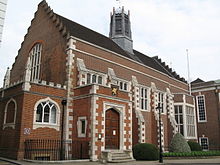
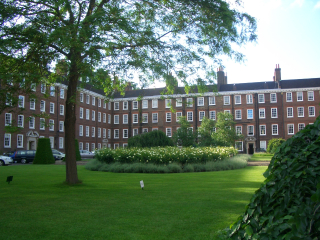
Gray's Inn Hall The inner square at Gray’s Inn
(1:37 minutes)
The Foundations of the Inn
Gray's Inn originally formed part of the Manor of Purpoole belonging to the de Grey family, the probable source of the current name. Sir Reginald de Grey, who died in 1308, was Chief Justice of Chester and Sheriff of Nottingham.
In 1370 the Manor House is described for the first time as a "hospitium" (a hostel). It seems probable that the "hospitium" was a learned society of lawyers who housed apprentice lawyers in their ‘chambers’. The students used the Hall of the Manor as an ‘Inn’ in which to dine and hold their legal debates and ‘moots’ which formed part of their training.
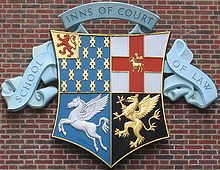
The coats of arms of the four Inns of Court
The Golden Age
During the 16th century, the Inns prospered greatly, attracting a broader culture – good manners, courtly behaviour, singing and dancing came to the fore. The period was known as the “Golden Age” of the Inn, and Queen Elizabeth I herself was the Inn’s Patron. At this time the Inn was renowned for its “Shows” and there can be little doubt that William Shakespeare played in Gray’s Inn Hall, [2] where his patron, Lord Southampton was also a Member.
Tradition claims that the Great Screen was built from the timbers of the Nuestra Señora del Rosario, the flagship of the Andalusian Squadron of the Spanish Armada in 1588. Diagonal rope marks can still be seen on the woodwork.
The stained glass within the Hall was moved to safety during the Second World War and thus preserved. Some of the exquisite windows in the Hall date back to 1462.
Did you know?
Those studying to become barristers must belong to one of the four Inns of Court and, since the 17th century, in order to be called to the Bar, students must, as well as passing their exams, dine at their Inn – today at least 12 times.
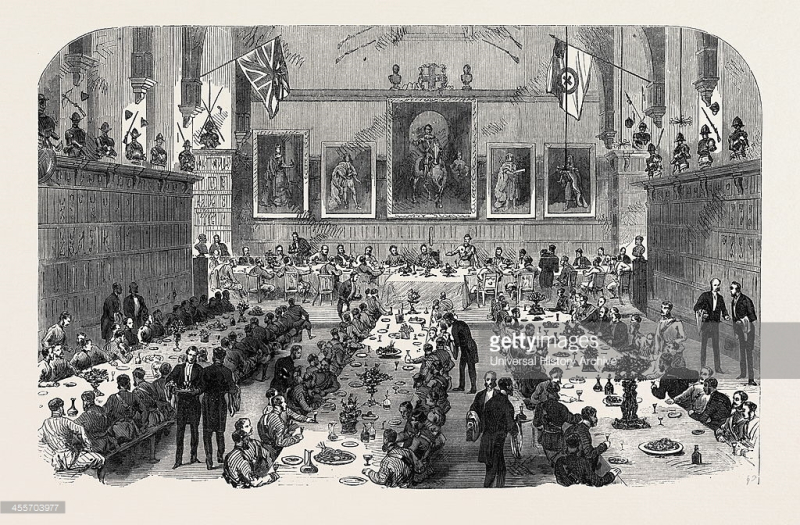
Another unusual fact – traditionally English barristers must never shake hands. There is much speculation as to why, perhaps involving trust and ‘gentlemanly’ behaviour. Recently, however, some members of the profession have begun to break with this tradition.
Famous names at Gray’s Inn
Among those linked with Gray's Inn, Francis Bacon (1561-1626), statesman, philosopher, jurist, scientist, orator, linguist, Attorney General and Lord Chancellor of England was trained at the Inn and became its treasurer.
Leading figures also include five archbishops of Canterbury, and Master of the Inn Sir Winston Churchill and Mr Franklin Roosevelt first met in 1918 at the high table within Gray’s Inn Hall.
Juliette Scott
Bloggers notes:
[1] Gray's Inn has a special sentimental significance for me. My mother, who was apparently the first woman barrister in Britain (a distinction claimed by a contemporary of hers who also completed her law studies in 1922) was enrolled at Gray's Inn, which is the subject of this article.
Jonathan Goldberg
[2] In Great Britain and certain Commonwealth countries there are two kinds of lawyer: barristers and solicitors. Barristers (called trial attorneys in the United States) have two roles – to give legal opinions and to represent their clients before the Courts. The word “barrister” goes back to the time when courts had a wooden bar behind which the judge sat and barristers pleaded from the other side. The expression “to be called to the bar” is used in England and elsewhere to refer to a person that earns the right to enter the profession of barrister. Although the word “barrister" is not used in the United States, all American lawyers must be members of the Bar and registered with the Bar Association in order to practice.
Solicitors, on the other hand, deal with wills, conveyancing, and other legal duties. They cannot plead in Court, apart from certain cases in magistrates’ courts. The work of a solicitor might be compared with that of a notary in France. In the United States, notaries are not lawyers. Their duties consist of authenticating signatures, a service for which they generally charge 10 dollars.
A barrister’s offices are referred to as “chambers”. A person learning the profession of barrister is a “pupil” and the final stage of training at a barrister’s chambers is called “pupillage”; those learning to be solicitors are known as “articled clerks” or “trainee solicitors”.
In England at the present time, the professions of barrister and solicitor cannot be practiced concurrently.
[3] The article “Satirical expectations: Shakespeare’s Inns of Court audiences”, published by the Société Française Shakespeare considers the relationship between two plays and their late 1590s audiences. After establishing the influence of the men of the Inns of Court as an audience “segment” in this period, it argues that both Shakespeare’s Twelfth Night and Marston’s What You Will respond to some of the shared experiences and interests of this group.