Pont Neuf, Paris
Pont Neuf, Paris
Japanese Gardens
Japanese Gardens
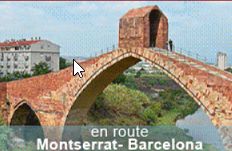
Montserrat, Barcelona
en routeMontserrat- Barcelona
Tower Bridge, London
Skip to content

English Spelling in Canada

(From Wikipedia, http://en.wikipedia.org/wiki/Canadian_English)

Canadian spelling of the English language combines British and American rules.

  • Most notably, French-derived words that in American English end with -or and -er, such as color or center, usually retain British spellings (colour, honour and centre). While the United States uses the Anglo-French spelling defense (noun), Canada uses the British spelling defence. (Note that defensive is universal.)
  • In other cases, Canadians and Americans differ from British spelling, such as in the case of nouns like tire and curb, which in British English are spelled tyre and kerb.
  • Words such as realize and paralyze are usually spelled with -ize or -yze rather than -ise or -yse.
    (The etymological convention that verbs derived from Greek roots are
    spelled with -ize and those from Latin with -ise is preserved in that practice.)
  • Some nouns take -ice while matching verbs take -ise – for example, practice is a noun and practise is a verb.
  • Canadian spelling sometimes retains the British practice of
    doubling consonant when adding suffixes to words even when the final
    syllable (before the suffix) is not stressed. Compare Canadian (and
    British) travelled, counselling, and controllable (always doubled in British, sometimes in Canadian) to American traveled, counseling, and controllable (only doubled when stressed). (Both Canadian and British English use balloted and profiting.)

Canadian spelling rules can be partly explained by Canada's trade history. For instance, the British spelling of the word cheque probably relates to Canada's once-important ties to British financial institutions. Canada's automobile
industry, on the other hand, has been dominated by American firms from
its inception, explaining why Canadians use the American spelling of tire and American terminology for the parts of automobiles (e.g., truck instead of lorry, gasoline instead of petrol).

A contemporary reference for formal Canadian spelling is the spelling used for Hansard transcripts of the Parliament of Canada (see The Canadian Style). Many Canadian editors, though, use the Canadian Oxford Dictionary, often along with the chapter on spelling in Editing Canadian English, and, where necessary (depending on context), one or more other references.

Les lecteurs sont invités à laisser leurs commentaires.

Christina Khoury, linguist of the month of January 2020

EXCLUSIVE INTERVIEW

Christina profile   Jonathan preferred

Christina Khoury
the interviewee


Jonathan G.
the interviewer

Preface

Our interviewee this month is Christina Khoury, resident of the city of Haifa, Israel.

The interview resulted from a stay by your faithful blogger at the Beit Shalom (House of Peace) Hotel, where Christina works. The undersigned overheard Christina conducting three consecutive conversations in Hebrew, Arabic and English.

Christina standing - cropped

  Christina - Beit Shalom

The interview is preceded by a short overview of Haifa and its history.

Jonathan Goldberg

Haifa, Israel

Built on the slopes of Mount Carmel, Haifa has a history spanning more than 3,000 years. The earliest known settlement in the vicinity was a small port city established in the Late Bronze Age (14th century BCE).


Haifa map 2 Map - Haifa Mediteranean

Haifa and Marseille are twin cities

Over the millennia, the Haifa area has been conquered and ruled by the Canaanites, Israelites, Phoenicians, Persians, Hasmoneans, Romans, Byzantines, Arabs, Crusaders, Ottomans [1] and the British, and since 1948 it is part of the State of Israel, in which it is the third largest city.

In 1100 or 1101 Haifa was besieged and blockaded by European Christians shortly after the end of the First Crusade and then conquered after a fierce battle with its Jewish inhabitants. Under the Crusaders, Haifa was reduced to a small fortified coastal stronghold. The army of Saladin [*] (founder of a Sunni dynasty of Kurdish origins) captured Haifa in 1187 and the city's Crusader fortress was destroyed. The Crusaders under Richard the Lionheart retook Haifa in 1191.

In 1799, Napoleon Bonaparte conquered Haifa during his campaign to conquer Palestine and Syria but he was forced to withdraw. In the campaign's final proclamation, Napoleon declared that he razed the fortifications of "Kaïffa" (as the name was spelled at the time) [2] along with those of Gaza, Jaffa and Acre.                                    


  Napoleon soldiers
 

Monument to Fallen Napoleon's soldiers in front of Stella Maris Monastery

Haifa was captured from the Ottomans in September 1918 by Indian horsemen of the British Army armed with spears and swords. It became part of the British Mandate of Palestine until 1948, when the State of Israel was founded.

The population of Haifa is heterogeneous. Israeli Jews comprise some 82% of the population, almost 14% are Christians, the majority of whom are Arab Christians and some 4% are Muslims. Haifa also includes Druze communities

[*] Salah ad-Din (or Salahu’d-Din or Ṣalāḥ ud-Dīn) was the first sultan of Egypt and Syria and the founder of the Ayyubid dynasty.

Port of Haifa   Haifa panoramic


Interview
:

Jonathan Goldberg: You come from a family with an interesting, cosmopolitan history. Tell our readers about that.

Christina Khoury: My paternal Grandfather was born in Torino, Italy and later moved to Genova where he got married and where my father was born and raised. My maternal grandfather had an Italian mother and Montenegrin father and was born in Constantinople in 1897. He met my grandmother in Constantinople, where she was also born. Italian was their mother tongue since they each had Italian mothers, although they were living outside of Italy.

In 1910 my maternal grandfather came from Constantinople to Haifa at the age of 13 with other members of his family to work on the Hejaz railway [3], first in Aleppo and Damascus and later in Haifa. With the outbreak of the First World War in 1914, construction of the Hejaz railway was halted. My grandfather remained in Haifa where he founded a factory. In 1925 he married my grandmother in Constantinople, the city of their birth. There, first my uncle (1927) and then my mother (1928) were born. In 1934 the family moved to Haifa when my mother was almost 5 years old. In Haifa, two more daughters were born (my aunts).

The family settled in Haifa and my mother and her siblings were educated in the local Christian Schools. They grew up in Haifa and spoke Italian.

During WW2, the family, being Italians and not part of the Allies in the area, were kept by the British as prisoners of war in different imprisonment Camps in what was Palestine under the British Mandate at the time, until 1948, when the State of Israel was established..

In 1948 my parents met in Haifa when my father, who was born in Genova, was on a short-term mission for the Italian consulate. They were married in Haifa in 1949 and my mother went to Italy for the first time as a young bride.

My parents settled in Genova, my father's birth town, and later moved to different parts of northern Italy. I was born in Genova but also lived in other regions of Italy before moving to Israel in 1984, at the age of 15.

J.G.: Tell us about the different languages that you speak:

C.K.: After moving to Israel from Italy I had to learn Hebrew and then continued my schooling in Hebrew, in Haifa. I had started English in middle school in Italy, but broadened my knowledge of this language here in Israel where I was able to practice it more and more. French is a language to which I was exposed already at a young age, since there are some members of the enlarged family who are French speakers, besides studying it in school. I picked up Arabic from hearing it here in Haifa from the Christian Arabs I became acquainted to. I learned German through my work, since the Hotel where I work belongs to a Swiss Organization, we get many German speaking guests. I took a course of German at the Haifa University and then practiced at work. My mother spoke 5 languages herself, so I must have inherited from her the love for languages.

J.G.: Of what religious faith are you and your husband.

C.K.: I was raised in a devout Catholic home but at an early age I chose Messianic Christianity, which is similar to the Evangelical Church.

My husband comes from a Lebanese Maronite Christian family. He was born in London to a British mother and a Christian Arab father, but came to Haifa as a baby. He grew up in Haifa and attended the Messianic Christian Community.

J.G.: In what languages do you speak to members of your family?

C.K.: I speak to my husband mostly in Hebrew, which was the language we were both schooled in here and is the main spoken language in Israel. I spoke to my late mother in Italian and I have continued that tradition by speaking to my daughter (who was born and grew up in Haifa) in Italian, and we both speak to my grandchildren in Italian. In that way five generations of my family on the female side have maintained their command of Italian (my grandmother in Constantinople, my mother in Italy, myself, my daughter and my grandchildren in Israel). At home, with my husband, our daughter and two younger sons and our son in-law, we alternate between Italian and Hebrew.

J.G.: How have you managed to keep a record of your family history?

C.K.: My mother memorialized her life in about 100 pages in Italian. I plan to translate them into English.

J.G.: What is Beit Shalom? What is your association with it?

C.K.: The Beit Shalom Hotel in Haifa belongs to a Swiss Evangelical (Protestant) organization. It was built in the 1970s. As a member of that Community in Haifa, I heard about a vacancy at the hotel 30 years ago, and I have been working there ever since.

J.G.: What kinds of guests visit the hotel?

C.K.: The Swiss organization arranges guided tour groups to visit the Holy Land, including a stay of several days in Haifa, with accommodation at the Hotel. In addition, members of the Baha’i religion, whose world center is in Haifa, find the location convenient because it is close to the magnificent Bahai terraces that occupy a large tract of Haifa. [4],[5] Guests and tourists both from Israel and abroad, enjoy our hospitality.

Haifa Bahai 1   Bahai 3

Bahai Gardens

J.G.: Haifa has several Christian communities. Can you describe them?

C.K.: in addition to our own messianic community, there are Latin Catholics, Greek Catholics and Greek Orthodox. The Catholics in particular enjoy close relations, and to a lesser extent there are contacts between them and the other Christians.

J.G.: What is the degree of ethnic and religious harmony between the Jews, Christians and Muslims of Haifa?

C.K.: It is a wonderful example of peaceful co-existence. It is manifested in everyday life: commerce, entertainment and mixed neighborhoods. Some cultural institutions aim to further encourage co-existence through intercultural meetings and activities.

J.G.: Generally, do Christians as a minority in Israel feel unsafe as they sometimes do in other parts of the Middle East.

C.K.: As far as we know and experience firsthand, Christians have full freedom and live a peaceful life in Israel, especially compared to what we hear about Christians living in the surrounding Arab Countries.

J.G.: There are different theories about the origin of the name Haifa. What do you know?

C.K.: No one is  sure about the origins of the name "Haifa", but it could derive from the name of Kepha (rock – the name of Saint Peter in Aramaic), or it could also be the combination of the words "Hof-Yafe" חוף יפה which means "nice beach", or "Chipa" חיפה  which means "covered" because of Mt. Carmel which covers over the area…

J.G.: You work at the hotel during the mornings and some of the evenings. What do you do in your spare time?

C.K.: I look after my grandchildren and help young students with their English studies.

—————

[1] Refers to the successors of Osman, founder of a dynasty that ruled the Turkish empire until its dismemberment after the First World War and the advent of the Turkish Republic in 1923.

[2] Haifa TintinIn French, before the adoption of the current spelling (Haifa), the city was known as Caïffe, Kaïffa, Caïfa, even Caïffa. It is this spelling that we find in the first version of Tintin in the land of black gold by Hergé, which appeared in serial in the Journal de Tintin. On the other hand, in the album, released in 1950, mention is made of Haifa (p.14). When the album was redesigned in 1971, Haifa gave way to the imaginary locality of Khemkhâh, just to get everyone to agree!

[3] Narrow gauge railway line, built between 1900 and 1908, to link Damascus to Medina (1,800 km). Ordered by Sultan Abdul Hamid II and carried out with German technical support, the project was intended to facilitate the pilgrimage to Mecca, promote trade and assert the Ottoman presence in the Arabian Peninsula. The Second World war of 1914-1918 sounded the death knell for the Hedjaz railway. Today, there are only a few segments left, in Syria and Jordan.

Haifa Hejaz map   Haifa Hejaz cover

[4] Baha’ism, also known as the Bahá'í Faith, is an Abrahamic and monotheistic religion that proclaims the spiritual unity of humanity. Members of this international religious community describe themselves as adherents of an "independent world religion". The Bahá'ís, disciples of Bahāʾ-Allāh, are organized around more than 100,000 centers, listed by the World Center in Haifa, around the world.

Haifa Carmelit[5]  The hotel is close to the underground metro, the "Carmelit", which was constructed by a French company and inaugurated in 1959 by David Ben Gurion, Israel's first Prime Minister. With only four carriages, six stations and one single tunnel-line of 1800 meters in length, the Carmelit is one of the smallest metro infrastructures in the world.

Sir Thomas Bodley – linguist of the month of October 2019


Of libraries and librarians –

two bibliophiles span six centuries in an imaginary interview in Oxford


Frank Egerton profile Thomas-bodley


Frank Egerton
{Photo Miriam Berkley)
L'interviewer


Sir Thomas Bodley
(1545 – 1613)
l'interviewee

“There are few greater temptations on earth than to stay permanently
at Oxford in meditation, and to read all the books in the Bodleian.”
Hilaire Belloc

Preface :

The Bodleian Library ("Bodley" or "the Bod") is the main research library of the University of Oxford and is one of the oldest libraries in Europe. It is second in size in the United Kingdom only to the British Library. It serves principally as a  reference library. Formally established in 1602, it bears the name of Sir Thomas Bodley, a fellow of Merton College, one of the 38 colleges making up the University.


Oxford University


In 2000, a number of libraries within the University of Oxford were brought together for administrative purposes under the aegis of what was initially known as Oxford University Library Services (OULS), and since 2010 as the Bodleian Libraries, of which the Bodleian Library is the largest component.

Over its various sites the Bod keeps 12 million printed books and allows access to more than 80,000 electronic journal titles. It also keeps ancient documents, manuscripts, papyrus, cards and sketches.  Much of the library's archives were digitized and put online for public access in 2015.


Bodleian_Library_entrance _Oxford

Frank Egerton profile

Francis (Frank) Egerton* is an author and a librarian and manager for the Bodleian libraries (Oxford). He also teaches and tutors on a number of University of Oxford creative writing programmes. He has a BA (Hons) Oxon and MA Oxon (English Literature and Language). His original qualification was as an Associate of the Royal Institution of Chartered Surveyors, but he abandoned his job as a land agent to read English at Oxford. *(frank.egerton@kellogg.ox.ac.uk.)

He reviewed fiction and non-fiction for newspapers including The Times and the Financial Times from 1995–2008. His first novel, The Lock, was published in paperback in 2003 and his second, Invisible, in 2010. The ebook version of The Lock reached the finals of the Independent eBook Awards in Santa Barbara in 2002. In The Times [of London] review of Invisible, Kate Saunders commented on "the author’s lively wit and acute understanding of the emotional landscape."

.————– 

Frank Egerton profileDon’t ask me how this works but it does. Hello, Sir Thomas.

Thomas-bodleyHello, Frank. It is an honour to meet you.


Frank Egerton profileThe honour’s all mine Sir Thomas. So, for the benefit of our audience, it’s with great pleasure that I’m here to interview Sir Thomas Bodley, after whom the world-famous Bodleian Library was named. Sir Thomas personally paid for and masterminded the library’s refurbishment, the original building having been abandoned and its book collection destroyed during the English Reformation. An outstanding achievement, Sir Thomas, for which the world will always be grateful.

Bodley (small)It’s kind of you to say so.


Bodleian-Library

Bod History Faculty
The Bodleian Library's Radcliffe Camera

Frank Egerton profile

I should mention that earlier I took Sir Thomas on a tour of the library as it is now. First impressions, Sir Thomas?

Bodley (small)Still recognisable – and I’m always pleased to see the extension at the western end. That happened after my death. It balances the building and provides lots of additional space. I’m intrigued by the glowing glass windows that readers look into on the desks. I’d like to find out more about those and these ebooks you mentioned. No swords, of course.

Frank Egerton profileNo, I think they were banned quite some time ago. No coffee in this part of the building either. And definitely no smoking anywhere. But perhaps—

Bodley (small)I like to keep abreast of new things. I may not have caught up with ebooks but coffee – well that only came in fifty years after my time. And smoking – I remember Sir Walter persuading Her Royal Highness to try some. Clouds of smoke and everyone coughing. I think she saw the funny side in the end.

Bod sir-walter-raleigh
Bod Queen-Elizabeth-I
Sir Walter Raleigh Queen Elizabeth I


Frank Egerton profileNow, Sir Thomas, as you know, we’re particularly interested in languages and European culture here – as well as books and libraries—

Thomas-bodleyAll interconnected.


Frank Egerton profileQuite! Your experience of Europe came at an early age, Sir Thomas, didn’t it?

Bodley (small)Yes. I was born on 2nd March 1545 and my first journey to Europe was undertaken in 1555. Dad was a merchant in Exeter who had strong Protestant faith and who’d helped pay for the suppression of a Catholic rebellion in the west country. When Queen Mary came to the throne, our family fled, initially to Frankfurt and from thence to Geneva, where Dad set up a printing business – that must have had some influence on my love of the printed word! Europe seemed then to be the heart of Protestantism – at least where we were. We were with John Knox in Frankfurt and at Geneva I studied Divinity at the feet of Calvin himself – a tireless worker and an inspiration to us all. I also studied Hebrew and Greek. And of course, we were surrounded by people speaking different languages. After Mary died we returned but by then my west country childhood was but a distant memory.

Bod Mary Tudor Bof John Knox
Mary Tudor          John Knox

Frank Egerton profileWhat memories of Europe you must have had, though.

Bodley (small)True, but there was something frustrating about being so close to European culture and yet cut off from it by the discipline of the school room. I vowed to go back.

Frank Egerton profileBut first to Oxford, the city that became synonymous with the name of Sir Thomas Bodley.

Bodley (small)No sooner did we return than I was an undergraduate at Magdalen College. Back on English soil in September 1559 and a matriculated student before the year was out. My studies at the Geneva Academy stood me in good stead. I did well and in 1564 I became a fellow of Merton College. I was its first lecturer in Greek a year later. For a time I thought my career would begin and end in Oxford. But, there’s this restlessness in me – perhaps it was being uprooted at a tender age then glimpsing how huge the world is. Questing, questing – I always wanted more. I tried many different things. Languages were at the heart of things – don’t get me wrong – Greek and in particular Hebrew, the study of which I and another fellow promoted energetically, opening up the knowledge contained in texts written in that language. But then there was a string of other posts alongside my academic life – college bursar, garden master, deputy public orator. What opportunities there were!

Frank Egerton profile
And friendships,

Bodley (small)Certainly – one especially. At Oxford I got to know Sir Henry Savile – a cultured and steadfast man who would teach me so much when I started the library project at the end of the century.


Frank Egerton profileBut before that, travel and diplomacy.

Bodley (small)Travel, yes. I’d never forgotten the vow I made when I returned in 1559. Here’s what I wrote in my autobiography: “I waxed desirous to travel beyond the seas, for attaining to the knowledge of some special modern tongues, and for the increase of my experience in the managing of affairs…” I journeyed to France then to Germany and Italy, learning French, Italian and Spanish. I spent over four years in those countries. The languages fascinated me but so too did new skills I could use in the service of our nation. Under the patronage of Robert Dudley, Earl of Leicester, and Sir Francis Walsingham, I became a gentleman usher to the Queen and a member of parliament – though the latter was, sad to say, the least well executed of my duties. From 1585 until 1598, when I threw in the towel, my life was devoted to diplomacy and discrete negotiation—

Bod Dudley 1 a Bod Washingham 1
Robert Dudley, Earl of Leicester Sir Francis Walsingham


Frank Egerton profileSpying?


Bodley (small)We never thought of it in those terms. Not like your James Bond—


Frank Egerton profileJames Bond?

Bodley (small)I told you I like to keep up with things – though there are so many..

Frank Egerton profileSo not quite James Bond.

Bodley (small)Though I did have an impact on world events, I like to think, at least to begin with. When I was sent, alone, with letters from the Queen to Henry III of France after he had been forced to flee Paris, I was charged with “extraordinary secrecy”. Though I say it myself – and I did say it in my autobiography – the outcome benefitted not only Henry but “all the Protestants in France”. If only things had continued that way. There was meeting Ann, of course, and getting married, which were the greatest events of that period but then for nine years I lived in the Hague, not always with Ann beside me, endlessly trying to persuade the United Provinces first to support the Queen’s war with Spain and secondly to pay her vast sums of money for the privilege. Neither side would give way. I was caught between a rock and a hard place. Talk about the woes of being a middle manager!

Frank Egerton profileI know just what you mean!

Bodley (small)Listen to this – one of the Queen’s secretaries writing in 1594: “…her majesty hath had just cause these many years to have expected a grateful offer from the States of some yearly portion of the great sums by her majesty expended…” She wanted a return on her investment, and they claimed they thought she’d simply been doing them a good turn. It was impossible. And then there was the intrigue at court. I couldn’t abide it any longer.

Taylor Institution Library Oxford Bod Old Schools Quadrangle Library
Taylor Institution Library (Bodleian)
Photo Bodleian Libraries, University of Oxford
Main Bodleian Library 


Frank Egerton profileIn your own words, “I concluded…to set up my staff at the Library door in Oxford; being thoroughly persuaded that…I could not busy myself to better purpose than by reducing that place (which then in every part lay ruined and waste) to the public use of students.”

Bodley (small)I’d been lucky to escape with my head! And so I turned to a project that I’d had in mind for some years. When I was at Oxford as a student and young academic, there was no university library – the manuscripts that Humfrey, Duke of Gloucester, had donated had all been snatched under a law passed by King Edward VI and scattered to the four winds. Imagine that. Many were said to have been reused by bookbinders to cover less “superstitious” publications. They were priceless classical texts. Because I’d been most fortunate in my marriage – Ann was a widow, whose first husband made millions at today’s prices out of buying and selling pilchards—

Bod humphrey- Bod Edouard
Humfrey,  Duke of Gloucester  King Edward VI


Frank Egerton profilePilchards?

Bodley (small)Like sardines, only tastier. We didn’t have children, so it seemed only right that the money should be used for the good of future generations of students. With invaluable advice from Sir Henry, I arranged for the old building to be refurbished and persuaded my acquaintances to donate books and bought others through booksellers who travelled to Paris and Frankfurt – and even to Italy – to find them. As Sir Francis Bacon said of the library, it was an  “Ark to save learning from deluge”. We collected European texts mainly but also books in Arabic and Persian – one two in Chinese, though no one could read them then.

Bod latin sign


Bof Divinity School interior

Entrance to the Bodleian Library                                                                                                                  Divinity School 

Frank Egerton profilePeople considered Chinese books to be curiosities, didn’t they, and of no real value?

Bodley (small)I didn’t – someone had taken all that trouble to write those characters, and someone else had paid them to do so. Who could know what wisdom the books contained? But I did know that one day a scholar would come to Oxford who would unlock their secrets. Soon we had scholars visiting from beyond our shores – twenty-two in the first two years. In 1610 I made an agreement with the Stationers Company, whereby they would give the library a free copy of every book they registered.

Frank Egerton profile.Which is still in place today – though many of the copies are now given as ebooks.


Bodley (small)Ebooks again! Well, like every library, we were soon running out of space, so I had to pay for an extension. A proud moment in the library was when King James visited – I’d been knighted for my services the year before. But towards the end of the project and before the next, much bigger extension could be built, I knew that my time was near and I passed over on 29th January 1613. And here I am.

Frank Egerton profileAnd here you are indeed. And very much still here in Oxford is your library for which the whole world thanks you. Sir Thomas Bodley – library legend!

Bodley (small)Thank you for inviting me! It's been a pleasure. Now, when we get to the green room you must tell me about these ebooks…


Bodleian 14 Bodleian 16
 Codrington Library, All Souls College  St Edmund Hall Library 

The libraries shown above are not those of the Bodleian unless so indicated.

Bibliography: 

Bodley, T., & Lane, J. (1894). The life of Sir Thomas Bodley, written by himself. [La Vie de Sir Thomas Bodley, écrite par lui-même] Retrieved from https://archive.org/details/TheLifeOfSirThomasBodleyWrittenByHimself/page/n5.

Centre for Editing Lives and Letters, in partnership with the Bodleian Library. (n.d.). The diplomatic correspondence of Thomas Bodley, 1585-1597 [La correspondence diplomatique de Thomas Bodley, 1585-1597]: DCB/001/HTML/0462/008. Retrieved from http://www.livesandletters.ac.uk/cell/Bodley/transcript.php?fname=xml//1594//DCB_0462.xml.

Bodleian Libraries. (2015). Marks of Genius: Novum organum (new instrument) [Signes de génies: nouvel instrument]. Retrieved from https://genius.bodleian.ox.ac.uk/exhibits/browse/novum-organum-new-instrument.

Clennell, W. (2013, May 30). Bodley, Sir Thomas (1545–1613), scholar, diplomat, and founder of the Bodleian Library, [Bodley, Sir Thomas (1545-1613), érudit, diplomate, et fondateur de la bibliothèque bodléienne] Oxford. Oxford Dictionary of National Biography. Retrieved from https://www.oxforddnb.com/view/10.1093/ref:odnb/9780198614128.001.0001/odnb-9780198614128-e-2759.

Wright, S. (2008, January 03). Bodley, Laurence (1547/8–1615), Church of England clergyman [Bodley, Laurence (1547/8 – 1615), ecclésiastique de l’Église anglicane]. Oxford Dictionary of National Biography. Retrieved from https://www.oxforddnb.com/view/10.1093/ref:odnb/9780198614128.001.0001/odnb-9780198614128-e-2758.

Tyack, Geoffrey. Bodleian Library : Souvenir Guide [La bibliothèque bodléienne: visite guidée]. Revised ed. Oxford, 2014. Print.


Additional Reading:

A History of the Bodleian Libraries


Brian Harris – linguist of the month (2nd part)


E X C L U S I V E   I N T E R V I E W 
(Part 2)

The interview below was conducted between Calgary, Canada  and Valencia, Spain

Here is a link to the first part of this interview: https://bit.ly/2lYSfyS


Susan Vo cropped
Susan Vo – interviewer
French-English interpreter

Brian Harris
Brian Harris – interviewee
Arabic-English interpreter

Calgary Valencia
Calgary, Canada   Valence, Spain

Our interviewer, Susan VO is a French Interpreter with 14 years experience as a staff member and freelancer with the United Nations, the Canadian Federal Government and in the private sector. She is an alumna of the the School of Translation and Interpretation at the University of Ottawa, which Brian Harris helped developed. She was Linguist of the Month on this blog: her interview can be found here and here.

Our guest interviewee, Brian HARRIS, has just celebrated his 90th birthday. His long, interesting and prodigious career in the theory and practice of translating and interpreting, as well as his strong interest in history,  is reflected in this interview. Special mention should be made of the fact that he coined the term 'translatology' for the scientific study of translation.  (In the 1970s, a French professor of translation, René Ladmiral,  introduced traductologie in French. Traductologie caught on and was soon borrowed into other Romance languages as traductología, etc.; translatology never caught on and was eclipsed by ‘translation studies’.) Natural translation is Harris' most important contribution to translation studies. In the early 1970s he began to notice that while he was supposedly teaching university students to translate, many people were doing translation successfully without such training; indeed that the untrained translators were doing more translating than the trained ones and often to just as high a standard. Many of the interpreters Harris worked with, including some from the Parliament of Canada had never had formal training. This led Harris to the conclusion that all bilinguals can translate within certain limits. In 1978, he and an assistant, Bianca Sherwood, published  "Translation as an Innate Skill", which has been described as the seminal article on natural translation.

Brian lives in Valencia, Spain with his wife and cats. His  blog is accessible at UNPROFESSIONAL TRANSLATION

———————

Susan Vo: How did the theory of Natural Translation play a role in developing the School of Translators and Interpreters at Ottawa University and how was it received by the academic community at the time?

The latter 50 years of my career have been dominated by missionary work for the Natural Translation Hypothesis (NTH), which is of more lasting importance than all the rest. I call it a hypothesis because there’s as yet no definite proof of it, but the indications are strong.

We can divide it into several propositions. The first is that all bilinguals can translate. I wasn’t the first to assert this; my mentor in translation studies, the Bulgarian semiotician Alexander Ludskanov, wrote it a decade before me. What’s more, he explained the difference between natural (i.e. untrained) translators and professional ones. He said that what we teach in translation schools is not to translate but to do so according to the norms and standards of a culture and a society.

The second proposition is that bilinguals’ universal ability to translate is innate. That’s to say, along with our ability to learn languages, we are born with the ability to translate between them. The key paper on this point is “Translation as an Innate Skill”, which I wrote with my student Bianca Sherwood in 1976 and which is available for everyone to read through my Academia.edu page.  The main argument for this assertion is the very young age at which bilingual children start to translate, and to translate quite well; they do it at around three years old and without any instruction from their elders. It’s analogous to the argument that Chomsky uses for innate language competence. We were very lucky, when we started writing the paper, to receive a generous gift of data from an educational psycholinguist in Toronto called Meryl Swain who had been recording a Quebec bilingual boy.

I wasn’t the first either to observe that young children can translate. That distinction belongs to a French linguist named Jules Ronjat who published a study of his own bilingual son in 1913.

But both Ljudskanov’s declaration and Ronjat’s description had gone unnoticed by translation theorists. My contribution was to point out the significance of their work and to continue it.

“Innate Skill” was generally received with scepticism or even outright ridicule by the community of professional translators and translation teachers. On the other hand, it was appreciated by some leading psycholinguists like Wallace Lambert at McGill University in Canada, David Gerver at Stirling University in Scotland, and Kenji Hakuta and his student Marguerite Malakoff at Stanford University in the USA. Also by one influential translation theorist, Gideon Toury , who had a model of his own called Native Translation that fitted in with mine.

Acceptance of the concept has advanced only slowly in the last 40 years, but some aspects of it are now mainstream, or almost. Language brokering studies, which started in the USA in the 90s, opened people’s eyes to the vast amount of translating done by children. The NPIT (non-professional translation) conferences and publications of the last decade have helped brush away the cobweb of misunderstanding in the old saying that “because you are bilingual, it doesn’t mean you can translate” (or interpret, for that matter).All around us, NGOs, manga and computer game publishers, Wikipedia and others depend on crowdsourcing their translations. Of course there’s a tradeoff. Mass production and amateurism can rarely matched skilled craftmanship, but it’s a price to pay to get the translations done.

The third proposition is that there are two pathways –as in other skills—from Natural Translation to Expert or Professional Translation. One is by formal instruction and the other is self-instruction by imitation. The second is the way we learn our first language, and it’s what Toury meant by Native Translation.

Finally I’ve gone back in my blog “Unprofessional Translation”, to an idea that was already held by semioticians like Ludskanov. It’s that what we call translation is the language specialization of a more general conversion of all kinds of signs, and it’s that general ability which we inherit.


Susan Vo: In your own words, with hindsight and observations of current trends, how would you say that Natural Translation and Simultaneous Interpretation are similar? What kind of traits do you believe all simultaneous interpreters inherently possess, (from a cognitive, cultural and even personality standpoint), how do these traits develop, either naturally or with deliberation?

The Natural Translation Hypothesis is a general theory about all translation (spoken, written or signed) and it says nothing that’s specific to simultaneous interpreting or indeed any interpreting. It goes without saying that simultaneous interpreters have to be competent translators, but NTH isn’t concerned with the quality of translations beyond a basic, childlike level; only with whether people can translate.  There are too many other factors in expert translation, such as family, schooling, work experience, travel, etcetera. Nevertheless, leaving aside NTH, there may well be features that are natural in the sense that they are, or they develop from, abilities that we interpreters are born with or that develop in us without being taught to us – which doesn’t mean that they can’t be improved by teaching and practice.

The one most commented on is mental speed. In simple terms, simultaneous interpreters have to be quick thinkers, but it’s not so simple. Simultaneous interpreting is not really completely simultaneous. There’s what linguists call the latency, or ear-voice span, typically two or three seconds. But that’s the most simultaneous interpreters can allow themselves if they don’t want to lose part of what the speaker is saying. Not everyone can keep this up. That’s why I and others have insisted on a shadowing test in admission exams. There have been magnetic resonance imaging studies recently that show there may be a physiological factor in mental speed, to do with the coating on the axons in our brains. But that doesn’t prove it’s inherited.

Another one often mentioned is personality. It’s true conference interpreters are performers, because they have to perform live often before an audience of thousands. So I’m inclined to think there’s a connection. Studies of the relationship go back to the 1950s, but without conclusive evidence or proof that it’s innate. So all we can say is maybe.

And the same applies to concentration, split-mindedness, stamina, even ability to work as a team.

As for “current trends”, the hot topic at the moment is automation. It’s true that interpretation only operates at present at the simple level required by NTH but it will improve. And automation is the opposite of natural.

Susan Vo: Machine translation, which had a pivotal moment in 1988, can be said to be the precursor of capabilities being used commonly today and advancing: google translate, translation apps, use of artificial intelligence in linguistic services. What are your thoughts on the role of MT, the role of the human translator, and where we are heading?

My interest in machine translation goes back a long way. It was in 1966 that I was recruited to a team at the Université de Montréal that was doing research on MT for the Canadian National Research Council. We were part of the second generation of MT researchers; the first was in the 1950s.  I was recruited as a linguist but I quickly understood that you can’t research MT without some understanding of computers. So I took courses in programming and mathematical linguistics and worked for three years as an assistant to a brilliant French computer scientist named Alain Colmerauer who was later the inventor of an AI programming language called PROLOG. We had some limited success by designing the prototype of an MT program called METE0 that has translated many of the Canadian official weather bulletins between English and French since 1974. But the computers and software of that epoch couldn’t have handled today’s AI. Instead we, like our French and Soviet contemporaries, used grammars and dictionaries.

Then in the late 1980s, long after I’d left MT for other interests and when computers had become vastly more powerful, there was a revolution caused by IBM’s introduction of statistical machine translation (SMT). It became the basis of today’s MT. I had played a small part in its beginnings with some work on the alignment of translations with their source texts, but that work was insignificant compared with IBM’s.

And then in 1996 I was given a new understanding of MT and AI by sheer chance. One of my Ottawa students named Bruce McHaffie came to me with a proposal to explore the use of neural networks for MT. (Neural networks are currently the dominant computer tools for what’s popularly called AI.)  I encouraged him and he succeeded in producing a feasibility study for his MA thesis. He was a pioneer; however, he only had primitive neural network software at his disposal and it was more than a decade before networks became mainstream.

As to whether AI produces better results than statistical MT, there is a saying that “The proof of the pudding is in the eating.” Try it for yourself; after all, it’s widely available on the web and it’s free. My own experience is that at present it’s only marginally better. But it does have one major advantage over SMT, which is that it doesn’t need preliminary close alignment of texts. Therefore, over time, there will be much more of it and that in itself should lead to further improvements because AI systems learn by experience.

In the long term, MT still faces problems that current AI cannot solve. One of them was foreseen by the Israeli researcher Yehoshua Bar-Hillel back in the 1960s. It’s the application of non-linguistic knowledge, or what he called encyclopedic knowledge, because we don’t have adequate computer representations of such knowledge. For example, the correct translation of such a simple sentence as “Cross the river” requires a French translator (or MT system) to know whether the addressee is a close acquaintance (Traverse la rivière) or not (Traversez la rivière) and to be sensitive to the difference in usage between European and Canadian French; and also to know whether it’s an ordinary river (rivière) or a large one flowing into the sea (fleuve). Legal translation requires knowledge of legal systems.

But in 1966 we couldn’t foresee MT like today’s, and so we just have to wait for the next 1980s revolution. Anyway, MT has reached a point of no return and the next step is MI (Machine Interpreting). It’s already on the horizon.


Brian Harris – linguist of the month of September 2019


E X C L U S I V E   I N T E R V I E W 
(Part 1)

The interview below was conducted between Calgary, Canada  and Valencia, Spain


Susan Vo cropped
Susan Vo – interviewer
French-English interpreter

Brian Harris
Brian Harris – interviewee
Arabic-English interpreter

Calgary Valencia
Calgary, Canada   Valence, Spain

Our interviewer, Susan VO is a French Interpreter with 14 years experience as a staff member and freelancer with the United Nations, the Canadian Federal Government and in the private sector. She is an alumna of the the School of Translation and Interpretation at the University of Ottawa, which Brian Harris helped developed. She was Linguist of the Month on this blog: her interview can be found here and here.

Our guest interviewee, Brian HARRIS, has just celebrated his 90th birthday. His long, interesting and prodigious career in the theory and practice of translating and interpreting, as well as his strong interest in history,  is reflected in this interview. Special mention should be made of the fact that he coined the term 'translatology' for the scientific study of translation.  (In the 1970s, a French professor of translation, René Ladmiral,  introduced traductologie in French. Traductologie caught on and was soon borrowed into other Romance languages as traductología, etc.; translatology never caught on and was eclipsed by ‘translation studies’.) Natural translation is Harris' most important contribution to translation studies. In the early 1970s he began to notice that while he was supposedly teaching university students to translate, many people were doing translation successfully without such training; indeed that the untrained translators were doing more translating than the trained ones and often to just as high a standard. Many of the interpreters Harris worked with, including some from the Parliament of Canada had never had formal training. This led Harris to the conclusion that all bilinguals can translate within certain limits. In 1978, he and an assistant, Bianca Sherwood, published  "Translation as an Innate Skill", which has been described as the seminal article on natural translation.

Brian lives in Valencia, Spain with his wife and cats. His  blog is accessible at UNPROFESSIONAL TRANSLATION

———————

Your early childhood and formative educational background are intriguing. You were brought up in London, you have a degree Classical Arabic and in Middle East History at SOAS and also studied at the American University in Cairo and did postgraduate work on Lebanese history in Paris. You then worked in Spain before emigrating to Canada.

Can you please talk about this fascinating trajectory, the origins of your connection to the Arab language and culture, how you acquired your other working languages, and what brought you to Canada?

I was supremely lucky to be born in England and so I learnt English as my first language for speaking and thinking. It saved me a lot of effort compared with what was needed by many of the people I worked with. But the London into which I arrived, though it's changed very much since then, was already a cosmopolitan city where one heard many languages. My first memory of a foreign language goes back to when I was about three and we were living in an apartment above a French family. When we passed their children in the morning the kids would sing out to us "Bonjour", and as my mother instructed me to reply "Good morning" I realised that that was what "Bonjour" meant to them.

My father was a big influence. He knew several languages. He conversed with my grandmother in Yiddish, won a prize for German at school, had visited Barcelona and picked up a smattering of Spanish, and — most important as it turned out — served with the British Harris - The Silent Wayforces in Egypt during the First World War. He had made friends there and learnt a little colloquial Arabic. He devised a little game for us children in which we spoke into a toy microphone imitating the sounds and intonation of European speakers we heard on the radio. Years later I read in Caleb Gattegno's book "The Silent Way" that one should begin to learn a language by its melody. That's true but it's rarely done in language courses.

I began serious study of languages when I went to secondary school at age 11. It was a modern school but it had a traditional grammar school curriculum. I was placed in the languages stream. There I learnt the elements of French, German and Latin and from good teachers. (In those days you needed Latin to get into Oxford or Cambridge.) Also English literature. Our language lessons and manuals included regular translation exercises, so they were my introduction to translation norms. It was there that I was taught "translate the ideas, not the words." We had little opportunity to speak the languages, since it was the war years. On the other hand, we spent a lot of time reading from the literatures, something I feel is missing from present-day language teaching. It was ironic that while the Germans were raining bombs and missiles down on us in London and we were holding classes in air raid shelters, we kids were studying a thousand years of German literature. Literature is something you can share with native speakers and it gives you an idea of the culture of a language. Even Latin; I still recall my favourite Latin text, Cicero's "Pro Sexto Roscio Amerino", a good Roman courtroom drama.


When the time came for me to go to university, I chose Arabic. There were two reasons. One was practical: the employment prospects. My school fellows who were good at languages were all going into European languages, but I saw there was a demand for Arabic from the diplomatic service and the oil companies and hardly anybody was responding to it. In those days the British Foreign Office even ran its own school of Arabic in the Lebanon. And again there was encouragement by my father. Indeed it was one of his contacts in Egypt who got me an invitation to go and study at the American University in Cairo. At that point my grandmother died and left me a small legacy that was just enough to finance the journey. So I hitchhiked across France and took a deck passage on an Italian ship from Marseille to Alexandria. I had a fabulous time in Egypt. It was in the dying days of King Farouk's regime, between Lawrence Durrell's "Alexandria Quartet" and General Naguib's army revolution, when Cairo was still a melting pot of peoples and languages. Besides Egyptian Arabic, I came into daily contact with Greek, Italian, French, Armenian and even Ladino (Judeo-Spanish). To accompany the weekly showing of American films at the university, there was an auxiliary screen alongside the main screen to accommodate all the subtitles.


Harris BOA LogoAfter I completed my degree at the School of Oriental and African Studies in London I could have gone on to graduate studies in the Arabic Department, but there was a snag. In those days it only taught Classical Arabic, i.e. medieval Arabic, and I, with an eye to employment and after my Cairo adventure, wanted Modern Arabic.

Then I heard  about a lecturer in the Middle East History department who used Modern Arabic for his research. He was Harris Bernard Lewis
Bernard Lewis
, later a professor at Princeton. He took me on as his student and I started a PhD on Lebanese history under him but first I had to do a qualifying second undergraduate degree in history. He did me an inestimable favour: he believed historians should work from primary documents so he got me a grant to go and do research in the archives of the Quai d'Orsay, the French foreign ministry in Paris. Another fabulous experience among the handwritten nineteenth-century consular correspondence. Of course it improved my French.


Then I discovered there were Russian sources for my thesis and Lewis had told me I would have to learn Russian when my life took a different turn and another language. I had been at school with a boy from Gibraltar who had been evacuated to London in 1940 when a German invasion of Gibraltar looked imminent. Like all native Gibraltarians, he was bilingual in English and Andalusian Spanish. When he went to university, his Spanish got him a summer job escorting parties of British holidaymakers to Spain for a London travel agency. He knew I had been to Spain (for all of two weeks!) and learnt a little Harris book coverSpanish from my father's dog-eared copy of Hugo's "Teach Yourself Spanish in Three Months without a Master". One day, on a Monday, he phoned me to say that family obligations would make it impossible for him to leave from London with a party of eighty the following Saturday; so could I stand in for him? To quell my doubts he told me that the people at the agency knew even less Spanish than me, and he gave me essential instructions for handling the work. In fact business was so good that the agency kept me on as well as him for that summer and the next one. Meanwhile my Spanish improved by leaps and bounds, and I even picked up a little Catalan, yet I never took a Spanish course. I tell people who ask me for advice about learning a language that the surest way is to get a job that forces you to work in that language. The Spanish job led to my first contacts with interpreting. I did so well that the proprietor of the agency offered me a job as his resident representative in Spain. It was an offer I couldn't refuse. I abandoned my PhD and went to live for a year in Madrid followed by a year in Barcelona.

That was the last language I learnt for a long time. Meanwhile my degree got me teaching assignments in Jordan and Morocco that revived my Arabic.

In 1999, after I had retired from university in Canada, I received another offer I couldn't refuse. It was for a temporary post in a university in Spain. As I result, I went back to Spain and eventually ended up in a village that's a suburb of Valencia. Most of the villagers are bilingual in Spanish and Valencian, which is a variety of Catalan. So I borrowed a school primer from our landlady and taught myself Valencian and read some Valencian literature.

If I moved to another country, which is unlikely now, I wouldn't hesitate to learn its language. We're born with an innate ability to learn many languages, even at an advanced age; but we need time, effort, an environment of native speakers and confidence.


What led you to help form the ambitious and formidable vision of founding the School of Translation and Interpretation at the University of Ottawa? What were the fundamental tenets of developing the school and program?

The University of Ottawa School of Translation was already six years old when, in 1975, I was parachuted into it from the Linguistics Department of the University to reform its MA program. I ended up reforming its BA program too and staying on as director for four years.

It was called “School of Translators and Interpreters” but in reality it only had one interpretation course (although it was taught by the head interpreter from the House of Commons, and several parliamentary interpreters of that generation took it). By 1970 I’d become a conference interpreter myself and I felt I could give substance to the denomination “…and Interpreters” by building an MA program. It was based on the European model of a strict admission exam, teaching consecutive interpreting before simultaneous, instruction by professional interpreters and a final exam before a professional jury. But it had an unusual addition: a compulsory real-life on-the-job period of experience (the ‘practicum’). “Real life” meant working as an active team member at an actual conference. That would have been difficult to impose in Europe because of AIIC opposition, and in the event I did have run-ins with some members of AIIC Canada, but fortunately we got cooperation from some sympathetic professionals. I persisted because of my belief that conference interpretation is a public performance and so young interpreters need to be exposed to the stress of performing before a live audience.

I made mistakes. One of them was to only consider interpreting courses at the graduate level.

Here in Spain it’s common practice in the universities for all undergraduate translation students to get one or two interpretation courses. So now I see value in that, but in those days I shared the common fallacy of equating all interpreting with conference interpreting, whereas in reality there are many other branches of interpreting that offer employment – court interpreting, business interpreting, community interpreting, telephone interpreting, etc. –  and that can be taught to undergraduates. Students should at least have some idea of what they are like and the most gifted students can be selected from among them for conference interpreting.

Another mistake was to teach only English and French interpreting.  That’s understandable in the bilingual Canadian context, but it prevents graduates applying for lucrative posts at the United Nations.

Until the present decade the University of Ottawa’s was the only conference interpreter training program and degree in Canada. Nowadays it continues under an agreement with the Translation Bureau of the Government of Canada, who supply the instructors. I’m proud that the very first graduate from the program, in 1982, nearly forty years ago, a student from Cameroon named Martin Chungong, is now the Secretary General of the Inter-parliamentary Union in Geneva.

The second part of this interview will be published soon.

Tina Kover – linguist of the month of July 2019


The Albertine Prize is awarded each year in New York for the best English-language translation of a work of fiction written in French. The winners of the Prize for 2019 are Negar Djavadi, the author of
D
ésorientale,  and the translator, Tina Kover.  Tina's translation, Disoriental,  was published by Europa Editions (May 1, 2018).

Négar Djavadi was born in Iran in 1969 to a family of intellectuals opposed to the regimes of the Shah, then to that of Khomeini. She arrived in France at the age of eleven, having crossed the mountains of Kurdistan on horseback with her mother and sister. Djavadi is a screenwriter and lives in Paris.


Albertine Desorientale + Djavadi

The Prize was awarded on June 5, 2019, at a ceremony at the Albertine Bookstore, in the presence of the author and the translator, as well as Lydia Davis and the French TV presenter and literary critic, François Busnel.

Albertine 4 participants

Négar Djavadi et Tina Kover,
at center

To watch the discussion (1 hour 18 minutes) that followed the ceremony, see https://bit.ly/32AYHNq.

The name of the Albertine Prize and of the bookstore of that name where it is awarded every year, is located on Fifth Avenue, New York, in a building belonging to the French Government in which the Cultural Services of the Embassy of France are housed. It is also the name of one of the characters in Marcel Proust’s “In Search of Lost Time (À la recherche du temps perdu), Albertine Simonet, the lover of the narrator Marcel. Albertine appears in several of the seven volumes of Proust’s work, such as In the Shadow of Young Girls in Flower (À l'ombre des jeunes filles en fleurs), Sodom and Gomorrah (Sodome et Gomorrhe) and The Prisoner (La Prisonnière).

Tina Albertine Prize J.T.Mahany cropped
Tina Kover
The interviewee
  J.T. Mahany
The Interviewer

Tina Kover has been a literary translator for nearly twenty years, translating works of both classic and modern literature including Alexandre Dumas’s Georges, the Goncourt brothers’ Manette Salomon, and Anna Gavalda's Life, Only Better. She studied French at the University of Denver and the University of Lausanne, Switzerland, and later worked in Prague teaching English as a foreign language. She currently lives and works in the northeast of England. Her translation of Négar Djavadi’s Disoriental was a finalist for the National Book Award for Translated Literature in 2018 and the PEN Translation Prize in 2019, before recently winning the Albertine Prize.

J.T. Mahanay is a translator of French literature. He received his Master of Fine Arts in creative writing from the University of Arkansas in 2018. In 2015, he translated Antoine Volodine's Post-Exoticism in Ten Lessons, Lesson Eleven. His translation of Bardo or not Bardo, also by Volodine, was awarded the debut Albertine Prize in 2017. 2020 will see the publication of his translation of Onze rêves de suie (Eleven Sooty Dreams) by Manuela Draeger. He is also an amateur teuthologist. 


E X C L U S I V E   I N T E R V I E W 

J. T. Mahany: The Albertine Prize is now the latest in a long parade of accolades that Disoriental has obtained. What is it about Djavadi's book you feel that has drawn so much acclaim (both in its original French and your translation)?

Tina Kover: I think there are several factors. Of course the writing itself is exquisite, and Négar Djavadi is a brilliant storyteller with a rare ability to make each reader feel as if she’s speaking directly to them. The book also touches on a number of issues that are of the utmost timeliness at the present moment: immigration (and refugee emigration), bigotry, sexual identity, acceptance. There is something in Disoriental for everyone; some intimate moment or observation that feels deeply personal no matter what you might be struggling with. This is a book that reaches across many lines and crosses multiple boundaries and I think that’s why people respond to it in any language.


J. T. Mahany: What was the process of translating the book like? Did you collaborate with Djavadi at all on the text? Did it differ much from the way you have translated the rest of your (rather prodigious, I may add) bibliography?

Tina Kover The process in itself was pretty much my standard one; I never read a book before I begin translating it and so I’m discovering the characters and the plot as both a reader and a translator, which, for me, at least, I think is key to retaining freshness and spontaneity in the finished work. Likewise, it’s not my general practice to communicate with authors during the translation process. They’ve created the original text in the solitude of their own minds and I prefer to do the same thing, though of course I welcome their input during the editing phase. I will say that from very early on I knew that Disoriental was something very special, the kind of novel that doesn’t come along very often, and I felt what I can only describe as a sort of reverence for its beauty as I got deeper into the story and realized what Négar was crafting and how ingeniously she was doing it.

  Albertine poster  
  “An extraordinary novel, both in incident and telling.”
Rivka Galchen
 

J. T. Mahany: A review of Disorientalin in The Thread compares Djavadi's work to that of Elena Ferrante. Do you agree with this comparison?

Tina Kover: I’m certainly no expert on Ferrante, but I can see why people might make that comparison. I think Danny Caine said it very well in the review you mentioned: both Négar and Elena Ferrante are incredibly adept at creating brave and fully-realized female characters, and both are able to draw intimate portraits set within a context of broader-ranging social and political climates. I think it says a great deal for the wisdom of the editors at Europa Editions, who published both authors, that they saw how important these books could be and how much people would take them to their hearts.


J. T. Mahany: Disoriental concerns itself with a narrator who feels as though she is caught between two worlds, a theme which has appeared in the works of a number of authors writing in French, such as Dany Laferrière and Akira Mizubayashi. What is it about this type of narrative that you believe is appealing to readers?

Tina Kover: Most of us, if not all, feel caught between two worlds at some point in our lives, whether physically, emotionally, or culturally. As an expatriate myself there is a great deal in Disoriental that struck a personal chord with me even though my own experience of leaving one country and settling in another was different in almost every particular. But people might also feel like they inhabit a different “world” because of sexuality or race or disability or any number of things. At bottom I think that “caught” feeling is about alienation, about feeling like one doesn’t belong, and that’s something we can all identify with.


J. T. Mahany: How did you first get into translation?

Tina Kover: I actually self-published my first translation, George Sand’s The Black City, which was then taken on by a wonderful literary agent, Sandra Choron, and subsequently purchased by the now-defunct Carroll & Graf. Things progressed from there. I’ve been very fortunate to come into contact with a lot of incredible people in the publishing world and to have had the opportunities I’ve had, and I feel especially privileged to be a translator right now, when literary translation is receiving so much interest and attention, and when it’s more important than ever to keep the lines of communication open between cultures, to promote intercultural exchange and understanding when so many seem bent on their destruction.


J. T. Mahany: Do you have any upcoming projects about which you'd like to speak?

Tina Kover: I’m extremely excited about the upcoming release of my translation of Mahir Guven’s Older Brother, which will be out from Europa Editions on October 8th. The book won the Goncourt Prize for a debut novel in 2018 and it’s another timely and extremely powerful depiction of life on modern society’s fringes, another story we all need to hear right now.

Additional reading:

Author Negar Djavadi Awarded 2019 Albertine Award for Her Debut Novel "Disoriental"
L'Officiel, June 7, 2019

A Persian Turned Parisian Insists: I'm Not an Immigrant, I'm an Exile
The New York Times, January 8, 2019


Carmella Abramowitz Moreau – linguist of the month of February 2019

AN INTERVIEW TO BE SAVOURED

Andrea profile Carmella  cropped

             Andrea Bernstein
             - the interviewer

Carmella Abramowitz Moreau
– the interviewee

This month our guest, Carmella Abramowitz Moreau, is a translator specializing in culinary translations from French, and living with her family in the 3rd arrondisement of Paris. The interview that follows was conducted by Andrea Bernstein, the spouse and personal chef of your faithful blogger. Andrea, like Carmella, was born in South Africa, where she obtained her doctorate in social work and was Professor of Social Work and Department Head at the University of Natal. After immigrating to the United States and working as an editor of academic texts, Andrea launched a new career as a consultant in the field of leadership development and was involved in the training of senior executives of major American companies. Both Carmella and Andrea are passionate about food and cooking. [1]

———————

Andrea Bernstein:  You grew up in South Africa, where many languages are spoken, (eleven of which are now designated as official languages) but where there was no French influence, unless you count the arrival of the Huguenots at the end of the 17th century. Despite Sorbonnethat, you gravitated to the French language, and to everything French, initially by moving to Montreal, at the age of 23, then to France where you completed the Diplôme de Civilisation française at the Sorbonne. You then went on to obtain a diploma in French-English translation, followed by a Masters in the same area. You married a Frenchman, and have lived for 35 years in Paris, where your children were born.  What stimulated your interest in learning French and in becoming sufficiently fluent to become a translator?  

Carmella Abramowitz Moreau: I completed my first degree at the University of the Witwatersrand in South Africa in Social Anthropology and English literature. My main regret regarding this degree is that I studied Zulu for only one year. My father was gifted in languages and read many alphabets. I think he helped instill in me my linguistic curiosity. As a child, I briefly took French lessons with a wonderful teacher but in high school I had to choose between French and Latin and I opted for Latin. My real attachment to, and love of, French began after my first degree, when I started studying French largely on a whim, taking intensive courses at language schools in both Lausanne and Paris, before going to Montreal where I completed a graduate diploma in language teaching. A year at the Sorbonne, also intensive, helped me on the path to fluency. Choosing to settle in a country seems to demand that one at least aspire to fluency. I was lucky to have always benefitted from excellent language and linguistics teachers.


AB: When I look at the list of your translations, it seems you have specialized in art, music and cooking (with some diversions into urbanism, microfinance, science and ethnomedicine). Let’s concentrate on culinary translation for the purposes of this interview. How did you get started in the field?

CAM: Carmella with pavlova My first cookbook translation fell into my lap after someone with whom I had studied translation recommended me to a publisher, knowing that I love cooking and baking, and that I had previously taken courses. One thing led to another, as tends to happen. Some time previously, I had taken weekly pastry-making lessons for a few years with a marvelous pastry chef, also a remarkable teacher. He demystified many aspects of classic French pastry-making for me. Although I don’t necessarily make this sort of thing any more, I can quite easily explain how to make Italian meringue. I can tell if there’s a serious typo in a recipe quantity, or an important ingredient inadvertently omitted, and so on. Since then, I’ve also taken short Viennoiseries courses in Viennoiseries and bread-making. But the task of explaining how to fold and roll out puff pastry never gets any easier – I suppose this is the case for any kind of a technical translation. Living in Paris certainly makes it easier to keep up with cooking trends, for example neo-bistro cuisine.


AB:  Personally I love reading cookbooks (even if I don’t make most of the recipes). What are some of the special challenges you’ve encountered in translating recipes?

CAM: The most challenging is translating complicated recipes by well-known chefs that are included in books targeted at the general public. They contain ingredients that are often not readily available even here in France, such as the latest vegetable or citrus fruit that they have an exclusive supply line for, a rare breed of meat, a rare species of fish, etc. I have to convey to the home cook how best to reproduce the recipe. Then there are the instructions that are incomplete or fiddly — recipes that top chefs use in their kitchens where sous-chefs are there to weigh out 43 grams of this and 127 grams of that. Meat cuts also differ from one country to another, even among English-speaking countries (and are far more intricate in France), as do weights of what constitutes egg sizes – an EU medium egg is more or less equivalent to a large US or Canadian egg, and Australia and New Zealand are different again. Added to the egg size difficulty is the French chef’s penchant for weighing yolks and whites – 75 g of egg white converts to about one-third of a cup, but who outside a professional kitchen likes to divvy up eggs? Percentages of butterfat in cream are not specified in certain countries but one needs to know what to use, Carmella ganachefor example, to make whipped cream or a certain type of ganache. Then there are the chefs who use idiosyncratic or regional terms for the preparation of part of a chicken or a common vegetable. At times, I resort to consulting my butcher or greengrocer. I long for the day when the US will switch to the metric system and kitchen scales become more widespread there, so conversions to the imperial system will no longer be necessary.


AB: How do you deal with the issue of a technical vocabulary? I believe there are often no exact equivalents for French terms.

CAM: I’m frequently asked if this poses a problem. It’s true that often there is no exact word for specific actions, and that French is very rich in technical culinary vocabulary. It’s generally quite easy to explain what has to be done in a few short, explicit phrases. Chiqueter, for example, a word I learned at pastry lessons, is the action involving scoring the edge of two layers of puff pastry to seal them together using the back of a small kitchen knife. And if you were wondering, yes, it tends to be recommended when making galettes des rois. I like to add the French word so that the reader becomes familiar with it.

Carmella SALT FATChanges in language as the world becomes increasingly foodier also need to be taken into account. The other day, I watched the series “Salt Fat Acid Heat”, in which Samin Nosrat made citrus suprêmes. For the moment I’m still sticking to “sections”, but I should think that soon all English speakers will happily be decorating tarts or cake tops with “orange supremes”. (Chicken breasts are another matter.) We have to juggle with the level of readers’ sophistication and how far foodie vocabulary has spread or will have spread by the time the book is published.


AB: Carmella repas-gastronomiqueGastronomy is part and parcel of French culture, as testified by the French gastronomic meal being included in the UNESCO list of world intangible heritage. Sitting down to enjoy a meal, whether gastronomic or not, is an integral part of the way of life. Is there any reflection of this facet in recipe books?

CAM: I feel I should preface my answer by saying that I see my task as twofold. Producing a book that will not only sell outside of France but can be used by the people who buy it, and making it as user-friendly as possible, while retaining the French touch in spirit. I don’t feel that making the necessary adaptations is a betrayal in any way, so long as I can remain true to the recipe. Having said that, there is a significant difference in the French and Anglo approaches to recipe writing. An English-language recipe will take the cook by the hand, so to speak, and guide him or her through each step (of course, depending on the target readership’s level of cooking). It will give pan sizes, cooking or baking temperature, an indication of doneness at each stage, the speed for the stand mixer and the length of time to beat at that particular speed. Many a French recipe, translated word for word into English, would look terse, or even unfeasible. Pan size? Oh, just use whatever you have. Indications of doneness? We’ve given you the cooking time – surely that’s enough! Storage instructions? But they go without saying. I suspect that the underlying reason is an assumption that the user of the cookbook will have cooked with a family member during childhood, or spent considerable time watching someone cook full meals, or know what the end result should be. In other words, a great deal of previous knowledge tends to be assumed, so I think that this is where the heritage comes in.

Ingredients have to be listed in order of use – a common recommendation in most English-language cookbook style guides, but not necessarily followed in France. If there is an instruction at the end of the recipe telling the cook to stir in the raisins that have been soaking
Carmella crepes-chandeleurin rum for 24 hours, I’ll start the recipe with an instruction to soak them 24 hours ahead. Here is an example I saw only yesterday: Now that we have transitioned from galette des rois season to la Chandeleur and crepes are everywhere, celebrity chef Thierry Marx published an online recipe for a crepe cake. One of the instructions is « Ajouter le lait préalablement porté à ébullition ». After so many years in France, I still find this discombobulating. As someone who cooks quite a lot, I transform it according to logical English-language order. Useful advice, though, is often a thorny issue, as notes generally appear at the end of the recipe in French – too late for some! If possible, I incorporate them as relevantly as possible, but layout does not always permit it.

Photos, too, may be problematic: English-speakers expect the end result to resemble the photo, but French books may provide an “artistic interpretation.” A recipe for a large cake may show several individual portions or be decorated with unspecified ingredients. In cases like this I find myself resorting to what a fellow translator told me is known as “creative insubordination”.


AB: You once told me that cultural issues crop up in the most unexpected ways. Please give us some examples of these.

CAM: Well, one needs to be au fait with all sorts of issues.  A chef who provided a recipe in a book I translated recently advised his readers to use only Iranian pistachios, for, in his opinion, nowhere else are such fine quality nuts produced. I don’t know how well this would go down in a country with a ban on many products from Iran, not to mention the fact that California is also a major pistachio producer.
Carmella lobstersThe solution is to find something a little neutral and bland (no pun intended) to say instead. Preparing live lobsters was an issue that triggered a long discussion with the translator with whom I was sharing a project. After research showing that crustaceans feel pain, Switzerland passed a law outlawing the boiling of live lobsters. How long will it be before other countries implement similar legislation? We do try to keep in mind the shelf life (again, no pun intended) of the recipes. Awareness of sustainability may not be as pronounced here as in the countries where the book is to be sold, so for seafood, for example, we may add a note advising the cook to check that certain fish, eels, or whatever, may be used responsibly.

Carmella community gardenPre-#MeToo, I gave a workshop to students working on the translation of a compilation of recipes from community gardens in Paris. A recipe for nettle soup was preceded by a short text on the long legs of a gardener wearing an attractive mini skirt. I asked the class what their reactions were. After some thought, the mainly women students said they found it perfectly acceptable, and a good reflection of the French way of life. The book was to be marketed to tourists in Paris and community gardens in large US cities. The dual-nationality American professor, who hadn’t really noticed this previously, was outraged and said, “Censor it!” I think it was her opinion that ultimately prevailed. 


AB: How do you deal with dishes that are well-known in France but possibly unknown to English-speaking readers?


When I have to translate a recipe for a little-known regional specialty, I usually ask if I can include a short history or explanation of the dish. I enjoy the extra research and if there is room, certain editors are happy to have a little bonus.

Carmella macaron-v-macaroonAgain, as the world becomes more and more foody, fewer explanations will become necessary. Some ten or fifteen years ago, we would have to explain that macarons are not the same as macaroons! Now, macaron doesn’t even require italics. Kouign amman seems to have emigrated from its native Brittany and hit the US, or at least parts of it.

Amusingly, I sometimes also have to deal with the reverse phenomenon. French chefs like to “frenchify” typically Anglo-Saxon recipes. I’m thinking of apple pie and cheesecake in particular, which they often explain to their French readers. The texts for these usually need complete rewriting and so I’ll draft a suggestion for the editor. It’s an opportunity for me to add a little culinary history or fun fact, though not every editor is receptive to this type of adaptation.


[1]

Carmella bookshelf Andrea bookshelf rotated
Carmella's bookshelf of cook books Andrea's bookshelf of cook books

Blog Editor's note: British spelling has been used in this interview.

Anne Trager, linguist of the month of November


Our guest linguist this month is an American, a Francophile, a literary translator, and the founder of Le French BookThis New York-based publishing house is dedicated to selecting, translating and publishing contemporary mysteries and thrillers from France, so as to bring them to readers across the English-speaking world. Anne lived in Paris for many years and now lives in Pibrac, a small town 15 kilometers west of Toulouse.


Anne banner

Website: www.LeFrenchBook.com


 LMJ : What is your background?

I grew up between Ohio and the southwest of the US and for as long as I can remember I dreamed about traveling overseas. Maybe it's because my parents were linguists, or maybe it's because they spelled my first names à la française: Anne, with an e, and Valerie, with ie. When I was a teenager, I was reading Gourmet Magazine religiously and experimenting with Mastering the Art of French Cooking (by Julia Child). At the time, the best place to learn to make really good food was Paris. So, I studied French and went to Paris as soon as I could. I trained as a chef and continued to study French (and a little Chinese). It didn't take me long to begin translating and interpreting. Later, I worked in publishing in France, doing project management, and I did a long stint in corporate communications. As far as translation is concerned, I always considered myself a generalist, and I translated anything and everything I could get my hands on. Translating fiction is different from other kinds of translation. Every book is an adventure in and of itself. This kind of translation is rooted in something deeper and broader than foreign rights acquisitions and the mechanics of getting a work from one language into another—it's about building bridges between cultures. It is very important for me to build a relationship with an author. Translation is like getting into the author's head; I think it's polite to knock first. I also believe in relationships when it comes to editors and other translators. For a book to work, you need to give it everything you've got in translation, in editorial, and in marketing. That's what we are trying to do with Le French Book.


LMJ :What led to the creation of Le French Book?

Le French Book

What if you could discover France while reading French crime fiction in English? This simple question sums up the whole project behind Le French Book and probably also my vision of life as an American living in France for so many years. I always loved mysteries and thrillers and, I must admit, this is almost the only genre I read. When I discovered French crime fiction novels, I was amazed by the richness and creativity of a great number of French authors. So I read, I read, I read. Then, I realized that only very few of these books were available in English and the idea dawned on me: these books need a greater audience and I must help English-language readers to discover them. So, I put together a team, including co-conspirator Fabrice Neuman, aka The French Connection; Amy "Red-line" Richards, translation editor sometimes known as The Slasher; and Jeroen "Bleeding in the Gutter" ten Berge, cover artist. My co-translators include Julie Rose, Jeffrey Zuckerman, Sophie Weiner and Sally Pane.

Anne TragerAnne Trager


    Julie Rose       Jeffrey Zuckerman


                                Sophie Weiner          Sally Pane


LMJ : How do you choose the titles you translate?

I spend a lot of time reading, and getting everyone I know in France to tell me what their favorite books are. I attend book fairs and talk to the authors. But the choice comes down to feeling. Our motto is, 'If we love it, we translate it.' Le French Book is about sharing reading pleasure. For now, we only publish mysteries and thrillers published in France by French authors. We keep an eye out for titles that will have something American readers can relate to. For example, we are translating the series known in France as Le Sang de la Vigne, by Jean-Pierre Alaux and Noël Balen, which we call the Winemaker Detective series. This works well because of the very strong link in people's minds between France and fine wine. We also are publishing the Paris Homicide series by Frédérique Molay, who won the Prix du Quai des Orfèvres with the first title The 7th Woman. In this series, the city of Paris is a character. We also look for titles that strike us as particularly interesting for whatever reason. White Leopard by Laurent Guillaume is set in Mali. The Greenland Breach and The Rare Earth Exchange, a climate thriller and a financial thriller respectively, are by Bernard Besson, a former top-level spy who is spot on when it comes to espionage and what is at stake in geopolitics today. David Khara's Consortium series makes a strong connection to WWII and today's scientific research and transhumanism. The Paris Lawyer by Sylvie Granotier has rolling countryside, hidden secrets and a quest for the truth. The Collector by Anne-Laure Thiéblemont has the merciless microcosm of Paris art galleries. And the Antoine Marcas series by Eric Giacometti and Jacque Ravenne gives an action-packed look into Freemasons, aside from having sold 2 million copies worldwide.

To sum up, we look for great stories, with that additional je ne sais quoi that makes us all dream about Paris or France, along with pace and suspense and good writing.


Treachery in Bordeaux cover     The Collector cover     Freemasons, gold, conspiracies, and freedom
             1                               2                                 3

1. Mission à Haut-Brion, Jean-Pierre Alaux & Noël Balen;
    Librairie Arthème Fayard,
2. Le Collectionneur,  Anne-Laure Thiéblemont, Editions Liana Levi, Paris
3. Le Frère de sang, Eric Giacometti & Jacques Ravenne, Fleuve Noir, Paris

LMJ : Do you think crime fiction sanitizes crime?

I think that good fiction changes the way we perceive the world, it shifts our awareness, at least for the period of time we are reading the book. I would say that crime fiction is one way to process and deal with senseless violence that is all around us. It's a little off topic, but I'm reminded of something one of our authors said. David Khara said, "The idea for The Bleiberg Project came to me after listening to a woman who survived the death camps. Three things struck me. The first was her sharp sense of humor. She said that prisoners inside the camp made jokes whenever they could. Humanity cannot be destroyed as long as laughter is possible. It becomes an act of resistance. The second thing was her will to survive, no matter the obstacles, no matter the horrors. And finally, she was living proof that to remember and understand History is the best, and maybe the only way, to avoid repeating our mistakes."


LMJ : What does the future hold for Le French Book?

We want to keep publishing entertaining books, serving as a bridge between creative contemporary France and the English-speaking world. We also want Le French Book to become the synonym for great books in the mind of readers; no matter which book you choose among the ones we publish you're sure to have a good time reading it. Upcoming titles include more in the Winemaker Detective series. The most recent one, just out, is Red-handed in Romanée-Conti, a tale of hail and murder during the grape harvest in Burgundy. The next Paris Homicide mystery is on the schedule for January, and it will be published by Amazon Crossing: Looking to the Woods. Soon, we will also be launching a new culinary mystery series called Gourmet Crimes, by Noël Balen and Vanessa Barrot. The first title is Minced, Marinated, and Murdered.

       A fun French mystery, with wine and food and travel.     Image result for Looking to the Woods paris homicide     Image result for Noël Balen and Vanessa Barrot. The first title is Minced, Marinated, and Murdered.

                        1                                            2                                               3

1. Flagrant-délit à la Romanée-Conti, Jean-Pierre Alaux & Noël Balen, Librairie Arthème Fayard, Paris
2. Copier n'est pas jouer, Frédérique Molay, Amazon Crossing
[French and English versions available on January 17, 2017;
may be pre-ordered now.]

3. Petits meurtres à l'étouffée, Noël Balen & Vanessa Barrot, Points Policier

——————


.

otre blogueur fidèle est traducteur et interprète assermenté auprès du Judicial Council of California (hébreu/anglais, français/anglais). Il Opsimathya vécu sur quatre continents et a passé un an à Paris, où il a obtenu un diplôme en Civilisation française de la Sorbonne – un cas de opsimathie, vu le fait qu'il n'a jamais appris le français à l'école ni pendant ces années d'études précédentes en droit.  Il a été membre du Barreau d'Afrique du Sud et du Barreau d'Israël. Il a traduit en anglais RÉVOLUTION d'Emmanuel Macron. Il ne faut pas le confondre avec un autre Jonathan encore plus ancien – la tortue (âgée de 188 ans) en confinement sur l'île de Sainte Hélène  (comme Napoléon autrefois).   Les deux (Jonathan & Jonathan, non Jonathan & Napoléon) se sont rencontrés lors d'une visite de l'île effectuée par votre blogueur. Voir le reportage : https://bit.ly/2KS6Wxe

Jonathan (with glasses)

               Jonathan le traducteur

Tortoise

Jonathan la tortue
[*]  

Frank Wynne : linguist of the month, October 2016

FrankWe are honored to have as our linguist of the month Frank Wynne, prestigious literary translator (French>English, Spanish>English). Frank has won numerous prizes for his work. He received the IMPAC award in 2002, the Independent Foreign Fiction Prize in 2095 (these two awards being shared with the authors whose works he translated) and the Scott Moncrief Prize in 2008. [1]

 
For his translations from Spanish he twice received the Premio Valls Inclán - in 2012 (for Kamchatka de Marcelo Figueras) and in 2014 (for La Hora Azul / The Blue Hour of Alonso Cueto) in 2016.


Wynne sansal-harragaMore recently his translation of Harraga , written by Boualem Sansal, was awarded the Scott Moncrieff Prize for 2016. The juries who awarded these prizes were themselves literary translators. As Frank explained in our interview with him, seeing his talents recognized by his peers is all the more gratifying, because translation is a lonely trade.
 
Frank granted Jonathan the interview that follows while on a trip to Dublin, designated as UNESCO's City of Literature in 2010.


Ireland may take pride in having fathered four recipients of the Nobel Prize for Literature: Seamus Heaney, Samuel Beckett, James Joyce and William Butler Yeats. As for Frank Wynne, he has put Ireland on the world map of literary translation.


———————–

Le Mot Juste : I understand that you have no French family background and that your academic training in French was confined to four years of high school, followed by a short period at Trinity College, Dublin. You have also told me that your school study of French included no verbal training and that your first opportunity to speak French came when you went to live in Paris, having never previously visited France. Yet you have reached the pinnacle of your profession as a literary translator and you also clearly have a mighty command of French literature. Given the limited number of years in which you formally studied French, and the rather unconventional Irish method of instruction, yours is a rare case of someone who, after a slow start,  made a massive leap to the front of the pack of well-known literary translators. To take Julian Barnes as an example of another Brit whose depth of knowledge of all things French is very striking, his affinity to France was established at a very young age and consistently nurtured, whereas you had no similarly extensive early immersion.


FWFrank Wynne :I was born and raised in Ireland in a family with no French connection whatever, and in a resolutely monoglot culture, but the Irish education system insisted that in addition to learning the Irish language (which to my shame I can barely speak now), high school students should also learn at least one other language. I studied both French and German. There was no oral component to study or examinations – aside from a little reading aloud, we spent most of our time learning verbs by rote, parsing sentences, identifying particles, discussing clauses. We never held conversations in French, and were not required to take oral examinations. This meant that when I moved to Paris on a whim in 1984, I arrived in a country I had never visited, with a 19th century understanding of the language: I spoke much the way that Maupassant writes 'quant à moi', 'je vous saurai gré de bien vouloir me passer le sel"… and for the first month I had almost no idea of what anyone was saying. Naively, I had assumed that learning to speak the language was a lexical problem: I merely needed the words to express the same thoughts I would have expressed in English. I was shocked and fascinated to discover how language shapes thought and speech, to realise that the underpinning of language – the ideas, cultural references and connotations -  are not transferrable or translatable. This was the beginning of my passion for languages: I began to read as widely as possible and to immerse myself in slang, verlan, accents, dialects, in a desperate attempt to understand Frenchness – its sounds and signifiers, its codified meanings, its hidden references. I became so obsessed with language that I undertook my first translation (something I did simply to be able to share it with English friends) of Romain Gary's La Vie devant soi – a book as much about voices and the liminal spaces in language as it is a heartbreaking story about Momo and Madame Rosa.