——————————–
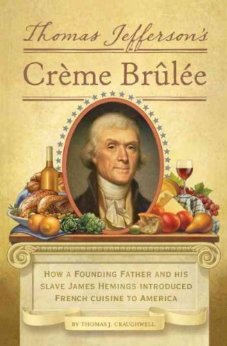 In Thomas
Jefferson’s Crème Brûlée, Craughwell, an experienced writer of mostly
historical non-fiction, has produced a beautifully presented and thoroughly
researched book exploring a lesser known aspect of the great man’s
achievements. Lurking behind the catchy, slightly flippant title is a far more
profound and far-reaching slice of American and European history than that
title implies. In fact, the book’s subtitle (How a founding father and his
slave James Hemings introduced French cuisine to America) left this reader
feeling spoiled by the book’s far greater scope, but also cheated by the paucity
of documentation supporting this key theme.
The
opening chapter is a useful exposé of American life in the early 1780s when
Jefferson was appointed to travel to Paris and join the American commission for
negotiating commercial treatise with European countries in general and France
in particular. We follow Jefferson and his elder daughter on their lengthy
journey to Paris before a similar exposé of the historical background in
France. The author is good at establishing just how unsophisticated America was
in comparison with Europe: Jefferson, a respected powerful man who cut a fine
figure in his native Virginia, felt hopelessly outclassed by the finery of
Parisian aristocracy, and was quick to acquire an entirely new wardrobe for
himself and his daughter. Craughwell also makes good use of the occasional amusing
anecdote: when the French agronomist Parmentier tried to introduce the potato
to France and met with suspicion and resistance, he countered this problem by
putting a twenty-four-seven armed guard around a field of potatoes on the
outskirts of Paris. As he had hoped, intrigued locals started stealing this
“precious” crop, and it was only a matter of time before it became the
invaluable staple that it is to this day.
One
key difference between France and America was in their attitudes to slavery.
Although the French were slave traders and slavery was vital to the economy of
her colonies, slavery was not tolerated in any form on the French mainland,
while it was commonplace and perfectly legal in America. Now, Jefferson was
keen to take his slave James Hemings to France with him and to have him trained
as a chef, but he had to go through a number of legal loopholes and to be
evasive with the truth in order to continue owning Hemings while in France. In
many ways Jefferson was an enlightened and benevolent slave owner, giving
Hemings a generous wage, financing his apprenticeship as a top-flight chef and
promising him his freedom if he trained up another slave as a chef when they
returned to his Virginia home, Monticello. But he was the product of his age,
viewing it as his right to own other human beings, and he selfishly manipulated
the terms of his agreement with Hemings to serve his personal interests.
Once
the Jefferson household is settled in Paris the reader starts to wonder when
the fun is going to begin, when Hemings will make his first crème brûlée and
how it will be received by the folks back home… but that is not really what
this book is about and, frustratingly, much of
the book’s central tenet regarding Hemings is necessarily based on
speculation; many sentences are loaded with those evils of non-fiction “sadly
no record remains”, “scholars believe”, “probably” and “would have”. There is,
for example, an interesting description of the Paris slums in all their squalor
and crime; fascinating it may be but it does little to drive this book forwards
and is included on the spurious grounds that Hemings “may have” strayed into
these dark and dangerous places.
Far
better documented is Jefferson’s comprehensive grand tour of France when he studied
different crops and farming methods, and took a genuine interest in humble
people’s living conditions. Jefferson loved much of what he saw and tasted, and
he never lost sight of his ambition to help his own country in every way
possible by sending home seeds and making extensive notes, sometimes supported
by complex illustrations. At one point he even traveled over the Alps by mule
to investigate how rice was cleaned in Italy, only to find that Italian rice
simply withstood the cleaning process better than American varieties because it
was a superior grain jealously guarded by the Italian authorities. He then took
the bold step of smuggling Italian rice (a hanging offence) back to Virginia,
but these imports were regarded with suspicion and it was decades before excellent
grade Italian rice was widely accepted and grown in the United States.
Interestingly,
much the same can be said for the exquisite cuisine and exotic ingredients that
Jefferson and Hemings took home to Virginia at the end of Jefferson’s term of
office when Paris was lurching towards bloody revolution. However persuasively
the author argues that Jefferson and Hemings “introduced French cuisine to
America”, the evidence does not satisfactorily support this assertion. The book
even strains to make the point that Jefferson must have served excellent French
food and wine at his historic dinner for James Madison and Alexander Hamilton
in July 1790, but no record remains of the meal and historians have merely
conjectured on the “likely menu”. Yes, Jefferson himself cherished his olives
and eggplants, he adored his fine wines and was the first to introduce
champagne as a celebratory drink in the United States, but much of what he was
offering to baffled American dinner guests was falling on untrained palates. He
did not start a great trend, in fact he was way ahead of his time; Americans
continued to rely on their familiar simple cuisine until the late nineteenth
century, and it was not until the intervention of Julia Childs in the 1960s that
Americans truly took French cuisine to their hearts.

Thomas J. Craughwell
It
seems fair to level these rather petulant criticisms at Craughwell’s book only because
– apart from some slightly lop-sided structuring and occasional repetitiveness –
it is an intelligent, lucid and fascinating read. Craughwell brings Jefferson
to life in all his complexity: a charming yet modest polymath who could display
unbearable grief at the loss of a child one minute and political acuity the
next, a man who never forgot his duty to his beloved country but recognized the
merits of other nations and their politics, and a “foodie” who took an interest
right down to the different varieties of obscure crops, and was not averse to
getting soil under his own fingernails despite his standing. If this book were
a wine, then, it would be illuminating and refreshing with plenty of body… but just
not what it says on the label.