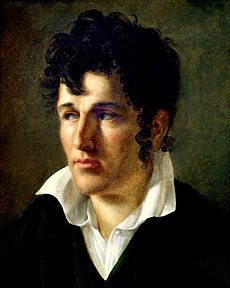
The Lost Romantic
At the end of the eighteenth and the
start of the nineteenth century, three great writers shaped and defined the
Romantic Movement in literature. François-René de Chateaubriand and
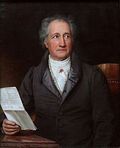
Goethe à 79 ans par Joseph Karl Stieler en 1828
Johann Wolfgang von Goethe were of the older
generations, Goethe’s literary reputation in particular being established
before the turn of the century, while Byron was of the younger. All three
achieved a pan-European readership exerting a potent influence well beyond
their own country and language. Each created a hero with which restless youth readily
identified. René, Werther, and Childe Harold were at the same time projections of their authors’
personalities and emblems of a changing intellectual world. Grounded in the
Classics, all three writers were inspired by Italy and Greece, and published accounts
of their European travels creating a new taste for cultural ‘tourism’, while
refreshing European literature with a direct draught from its primary cultural
source. All three were urbane, sophisticated, intellectually adventurous,
strongly individualistic but free of the extremist literary tendencies of many
of their contemporaries in the Romantic Movement. All three were moralists and
‘philosophers of life’, humanists of broad vision, deriving their essential
core from the subtler Roman values of Horace and Ovid, though laced with the
Greek turbulence of Euripides. And though all three in their literary work
passed through an initial Romantic phase to achieve in their later works a more
complex blend of Classical and Romantic attitudes, Goethe creating Faust Part II, Chateaubriand his Mémoires d’outre-tombe, and Byron Don Juan, their Romantic legacy remained
potent.
Yet their fates in English have been
widely different.
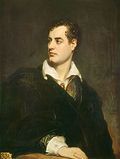
Lord Byron
Byron,writing in the language, was clearly immediately
accessible to readers of English, part both of a local and a European culture,
while the unfolding of his intense and colourful life guaranteed him notoriety
well beyond his purely literary fame. Goethe’s creation of Faust, as well as the cult of the individual which he fostered and
which surrounded him, rendered him the ‘great man’ of Weimar, and Faust has always been available in many English translations, along
with selections of his poetry, his Italian
Journey, and other works. But Chateaubriand has not been appreciated or even
respected in English to anything like the same extent, and modern translations
of his work have been unavailable, or available only in a highly edited and
limited form. Why has this been the case? Modern readers are more than familiar
with translations of Montaigne, of Voltaire and Rousseau, of Baudelaire and the
Symbolists, of Proust, of a plethora of French poetry, philosophy and
novel-writing, from Villon to Sartre. Why should Chateaubriand, one of the
greatest of French writers, be so neglected?
Firstly, he was not a poet, though
poetry was the perfect medium in his day for the expression of Romantic
restlessness, yearning, and the deep, even extreme, personal emotion that
characterised the movement. Chateaubriand is a master of prose style, and in his
deeply Romantic works his thoughts and feelings, involving for example Nature,
the movement of history, sensibility and exile, are expressed through his
heroes and heroines, as in the pages of René
and Atala, indirectly and in
controlled prose rather than impassioned verse. English Romanticism was and is
strongly focussed on its own poetic scene, while Chateaubriand’s name evokes
for the English no equivalent density of Romantic reference. He effectively
lacks a supporting cast, apart from perhaps Germaine de Staël. Early
Romanticism for the English is then essentially a poetic movement, paralleled
and partly inspired by German poetry, music, and painting. Chateaubriand lies
outside that frame of reference, while French poetry itself required time to digest
the impact of the Revolution and the change of sensibility it fostered, only
emerging as a major force later in the nineteenth century, through Hugo and
above all Baudelaire.
Secondly, Chateaubriand’s support for
monarchy, and strong religious faith, ran counter to the general tendency in
English Romantic literary circles in the early nineteenth century towards
republicanism, or at least the support of anti-establishment views and personal
liberty of political thought combined with a free-thinking attitude towards
religion which revealed itself in a spectrum of religious positions from
Wordsworth’s pantheism, derived from Leibnitz, to Byron’s agnosticism and
Shelley’s atheism. English Romanticism suppresses religion, certainly in the
form of the Established Church, while upholding the spiritual as a mode of the
personal and individual. Ironically Chateaubriand is sympathetic to republican
ideas and the need for social change, and it is rather his strong sense of
personal loyalty, perhaps also his empathy with the underdog, charming
qualities in themselves, which leads him to remain a royalist though seeking
reform and movement towards constitutional monarchy on the English model.
Royalist sympathies are not a feature of the English Romantic movement, often
the opposite is true. Again Chateaubriand’s religion, in its essential
compassion, moderation and spirituality forms part of the charm of his
personality, exemplifying in many respects the best features of Christianity,
yet generally failed to appeal in English literary circles where religion was a
primary domain of the few rather than the many, and was expressed through the
radical non-establishment views of Blake or the pantheistic vagueness of
Wordsworth. Coleridge upholds a religious tradition, true, but that is not
strongly reflected in his early and major poetry but rather in the later prose.
Thirdly there is a question of timing,
which Voltaire considered crucial as far as fame was concerned. Chateaubriand
was culturally isolated during the Revolution, when he lived in England and
travelled to America,
and then when he returned to France
culturally separated from the English literary context by the Napoleonic period
and its aftermath. His European travels were eclipsed for the English by
Goethe’s earlier Italian journey which had invoked the new Classicism and by
Byron’s contemporary adventures in Italy and Greece. His
journey to Jerusalem
was seen as primarily a religious experience and irrelevant from a literary
point of view or that of the new sensibility, the travels in Greece in
particular offering little new. His American novellas were fascinating in terms of expressing the European
relationship to Nature, and the prose of exile, but were again religiously
oriented and less extreme in reflecting the sensibilities of the Sturm und Drang movement than Werther had been or Childe Harold then was. Chateaubriand, lacking strong support from
the French literary scene, being in himself a unique phenomenon, went his own
way, and while strongly influencing French literature from Baudelaire to Proust
in his pre-occupation with time and transience, with the beauties of nature,
and in his stylistic excellence, his influence on English literature and
development was slight. To be partially
eclipsed by Goethe’s generation and Byron’s is a somewhat unenviable position
from a literary point of view.
Then, questions have been raised in England and America about
the truth and accuracy of his accounts of travel in America and in Greece. In the
case of America
the distances travelled appear surprising, the reality of the claimed meeting
with George Washington suspect, and the narrative vague and generic to the
point of elusiveness, though these issues can be rationalised, and there is no
direct evidence of deceit. In the case of Greece, much seems regurgitated
from the descriptions of previous travellers and there is doubt as to the sites
he actually saw and what he found there, though again there is no direct
evidence of false accounting. Elsewhere, especially in his later work,
Chateaubriand appears the soul of honesty, and any inaccuracies are very minor
and understandable in an age where referencing valid sources was often
difficult or impossible. Nevertheless the charges of distortion, exaggeration
and falsehood remain, much as the charges of plagiarism have tarnished
Coleridge’s reputation, or his political forays that of Ezra Pound. In all
three cases the charges diminish the author somewhat in our eyes but should not
blind us to the merits of their finest work. The issues raised are an
interesting test of our ability to address human failing, a theme dear to
Goethe in his development of the character and actions of Faust.
There was a further obstacle in the way of
Chateaubriand’s ready acceptance in England and America. The
work that best reveals the man and communicates the charm and depth of his
personality is the Mémoires d’outre-tombe.
One may quibble about the amount of space given over to Napoleon, in a
commentary which is not in itself ground-breaking, and the range of characters
from French history and society who are more meaningful to French culture than
English, but in the Mémoires a great
man comes alive at a great moment in history, and reveals to us a personality
blessed with wisdom, humanity, and wit. Two things however prevented the
English acknowledging the full power and greatness of the Mémoires; their bulk and the image of French cultural greatness
they seek to convey. Translators and publishers have jibbed at the former,
English self-centredness at the latter. So the Mémoires appeared in poor and highly edited translations, which
communicated neither the beauties of his language nor the wonderful experience
of exploring his complex personality over a wide extent of space and time. I
might call it the Proust experience. A set of extracts from À la recherche is as much use as a
condensed version of the Mémoires,
better than nothing, but by no means good enough.
As a result of all these factors
Chateaubriand has not been well served by his English translators, who have
proved few and far between. The extended Mémoires
are only recently available online in a sound English translation. And other
key works of his Romantic period, along with his travel writings, were until
now only available in antiquated and un-annotated editions. New translations
cast a fresh light on his literary stature.
Finally, in looking at his neglect in
English, it is perhaps right to point to the French literary tradition which
Chateaubriand develops and enhances. He is a moralist and philosopher of the
world who owes much to Montaigne in his profundity and essential humanity; to
the French translations of the Classics for his grasp of Greece and Rome, to
Voltaire for his incisiveness and ability to turn an aphorism, to Rousseau for
a certain attitude to nature and sensibility, despite his finding Rousseau
un-endearing as a personality. Chateaubriand takes what suited his temperament
from Romanticism, but stands aloof from its extremes, as Goethe did, as Byron
did in many ways. Chateaubriand is moderate, grounded, empathetic, and
spiritually humble though a proud man in secular life. He belongs to a France that
civilised Europe, offering gateways between
East and West, modulating and softening the harshness, deepening the culture,
and extending its influence to early America, alongside the influence of
the English language.
The English have often failed to
understand their debt to France,
and have often failed to appreciate the deeply cultured humanist middle-ground
in Europe that literary France has
occupied. Perhaps the European pre-Second World War generations appreciated
both more, and the pressures of the modern world have moved attention
elsewhere. Be that as it may, it is high time for a re-appraisal of
Chateaubriand in English. Hopefully new online translations, and the newer and
more thorough modern approach to the history of the Enlightenment and
Romanticism, will allow him to emerge once more in English with the honours
that he deserves.
Note: Selected
works of Chateaubriand, including the complete Mémoires, are freely
available online at the Poetry in Translation site www.poetryintranslation.com

A. S. Kline