William the Conqueror, Guillaume le conquérant, conquered England in 1066. After being crowned King of England, William handed out most of the lands that had belonged to the defeated English aristocrats to Norman-French Barons and others who had fought with him. The fact that the old English aristocracy was replaced may be seen from William's own Domesday book of 1086, which makes clear that of the many large landowners only four are English.
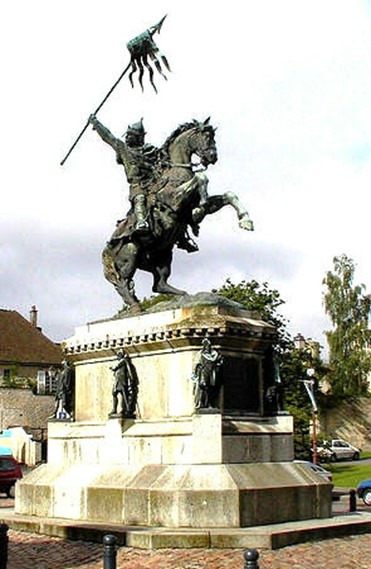
Statue of William
the Conqueror
in the town of his birth Falaise, France
Photograph courtesy
of Keith 1999.
The Anglo-Norman-French aristocrats soon built castles on their new land and their kitchens were staffed by Norman-French cooks. From letters and documents of the time we can see that the English names of cooked meats and cooked poultry names are taken from French, which confirms that the Norman-French were the cooks. The names of the live animals were the responsibility of the English kitchen help and farmers, and so they remained in Anglo-Saxon (English).
French – English ; Anglo-Saxon-German – English
Cooked food versus live animals:
|
|
|
The
language of the French cooks
|
The language of the kitchen help and
the farmers
|
|
Bœuf Beef
|
Kuh
– Cow
|
|
Jambon – Ham
|
Schwein, Swinan
– Swine
|
|
Mouton –
Mutton
|
Chase – Sheep
|
|
Porc – Pork
|
Bigge – Pig
|
|
Poulet – Pullet or chicken
|
Huhn – Hen
|
|
Venesoun
-Venison
|
Deor -Deer
|
Setting the tone for the Norman-French-English kitchens were the French queens of England. The first was William's wife, Matilda of Flanders, who was crowned Queen of England in 1068. Of the 14 queens of England in the nearly 400 years following Matilda, there were, I believe, 12 who were French-born, (including the two queens who were born in Navarre). That 400 year-long French influence on the English kitchen would have its effect on the English language and English recipes.
Traditional British dishes with French accents
I will use four British dishes to show the Norman- French and French roots in even what are considered traditional British dishes. Puddings are not included as they are a true British creation.
The traditional English and Irish breakfast
The traditional English and Irish breakfast is bacon and eggs, with fried or grilled tomatoes, mushrooms, pork or beef sausages, along with slices of the blood sausage called black pudding, and, of course, toast.
All of the ingredients noted above are seen on French tables though few, if any, are seen at a traditional French breakfast.
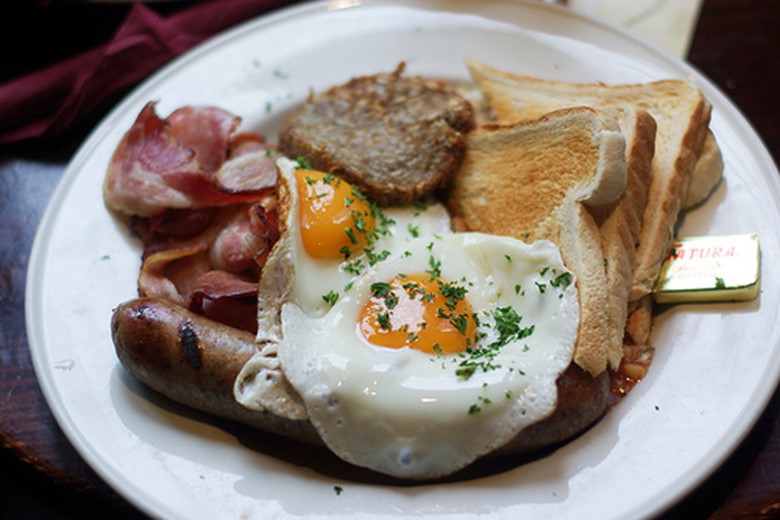
A traditional English or Irish breakfast
Photograph courtesy of Vanessa Pike-Russell
Bacon – The word "bacon" together with the word "lard" came to England from France, and today, in both English and French, bacon means the smoked, or salted meat from a pig. The second French word lard
now means bacon in French, but in modern English lard means pig fat, saindoux in French, which creates confusion for an English speaker ordering breakfast in France.
A French menu may offer:
Deux Œufs Brouillés et Deux Tranches de Bacon Grillé –
Two scrambled eggs with two rashers of grilled bacon.
or
Œufs au Lard Fumé – Fried eggs with smoked bacon.
An English speaker seeing Œuf au Lard Fumé without any explanatory translation and knowing that œufs are eggs, but not that lard means bacon in French, may well understand that menu listing to refer to eggs fried in pig fat! Two-hundred years ago eggs in both France and Britain eggs would have been fried in pig fat, but today that will not be seen in any French café that hopes to serve British tourists.
Eggs – A genuine Anglo-Saxon name, œufs in French
Mushrooms – The word comes from the old French word mousseron, now champignons in modern French; however, the word mousseron is still part of the French name for certain wild mushrooms. e.g. Le Mousseron, the St George's mushroom.
Tomato – The British and the French both received both the tomato and its name from the Spanish via the conquistadores; the original Aztec name was tomatl. However, until the end of the 17th century, both the French and the British considered tomatoes an ornamental plant. Who added the tomato to the English and Irish breakfast is unknown.
Sausage – The word sausage came to England as the French word saucisse in 1066. Then, in French, a saucisse included all types of cooked and uncooked sausages. Today, in modern French, a saucisse is a cooked and/or dried sausage including salami style sausages, with the term saucisson mainly used for a large saucisse. The term boudin is commonly used for uncooked sausages, including the types of pork or beef sausages that are grilled or fried for the English and Irish breakfast. In France a boudin blanc, is usually a pork sausage, and often part of light lunch or dinner; it will not usually be seen on a breakfast table.
Black pudding – A pig's blood sausage; in French this is the boudin noir. This sausage is a traditional British, Irish and French favorite. The boudin noir, the black pudding, will have been boiled before being sold but will still be fried or grilled before being served. The British and Irish versions of the boudin noir sausages are large sausages, much too much for a single person, and for breakfast only two or three grilled or fried slices will be served. Most French boudin noirs are shorter and thinner than most black puddings and are often part of a light French lunch or dinner. France also organizes an annual international competition for the best boudin noir, the best black pudding. From all over the world, in March, the lovers of the boudin noir including many from England and Ireland come to compete at the Foire au Boudin de Mortagne-au-Perche, the black pudding fair which takes place at that town in Normandy. If you love boudins noir, black puddings, then mark your diaries for the third Saturday and Sunday in March and call your travel agent or Easy Jet.
Toast – Toast, Pain Grillé. The word toster came to England from France when it meant grilled or to grill. The French have taken the Anglicized word toast and kept its modern English definition. Today, in France, the word toast is now more popular than pain grillé; however toast, even a toasted baguette, will only rarely be on a French breakfast table.
Ox-tail stew, a traditional British dish taken directly taken from Normandy
Ox-tail stew – This stew arrived in England in 1066 from Norman-France and has become a British and Irish tradition; in Normandy this stew was, and is still, called a hochepot.
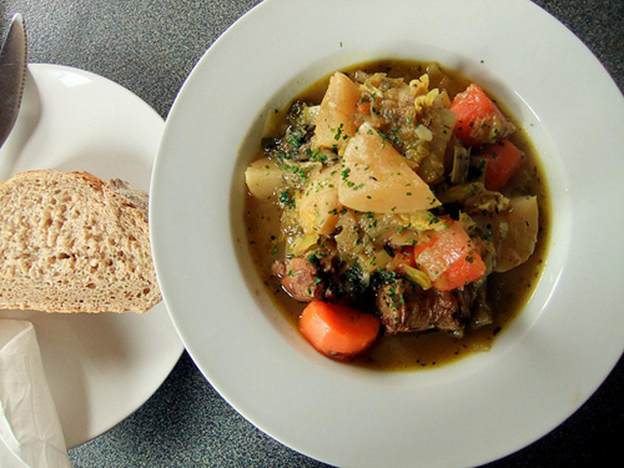
Ox-tail stew
Photograph courtesy of The Sun and Doves
The recipe for the Norman hochepot includes, apart from the essential ox's or cow's tail, almost everything that may be found lying around the kitchen; that recipe accounts for the word hodgepodge in English. In today's English, a hodgepodge typically means a mixture of odds and ends, miscellaneous items, and not specifically food. However, odds and ends are what made up the original Norman recipe, and so the Norman hochepot gave birth to the English word hodgepodge. There are vegetable and meat stews that can be found on menus in Great Britain and North America under the names "hochepots" and "hodgepodges"; however their recipes are mostly very different from the original hochepot and the meat stew will be made without an ox's tail. The British ox-tail stew began in Norman France.
Shepherd's Pie and Cottage Pie and their French connection
Shepherd's Pie and Cottage Pie – These are two very traditional British dishes, and very much a British comfort food. A shepherd's pie is made with lamb, or mutton, and a cottage pie is made with beef. These two traditional British dishes are among those most often denigrated by French tourists when they visit Great Britain; however, the origins of these two dishes are not Norman, rather they are 100% French. In France cottage pie, hachis Parmentier and shepherd's pie, Hachis parmentier d'agneau, are much loved traditional French recipes. A cottage pie will often be on French menus as Le Hachis parmentier Grand-Mère, which is Hachis parmentier prepared like Grandma did; on a French menu food prepared by Grandma is French for a comfort food.
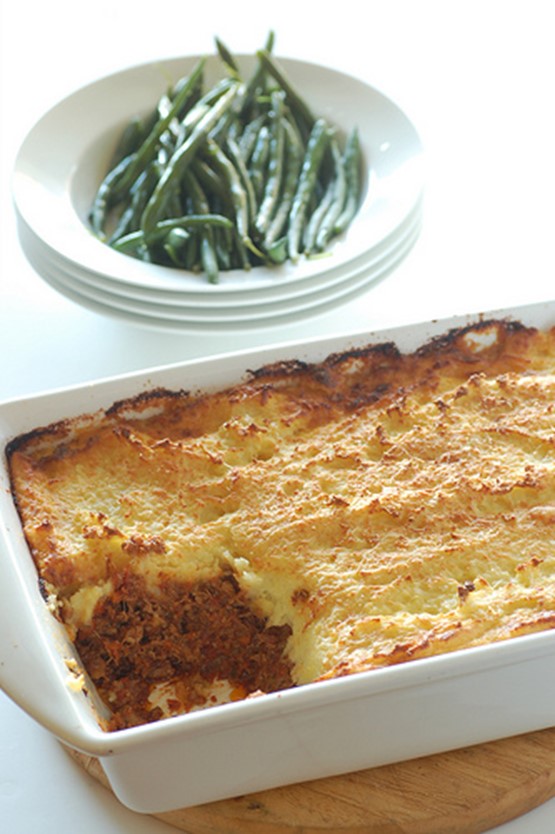
Shepherd's Pie
Photograph courtesy of jules:stonesoup
Hachis Parmentier is made with ground beef and chopped onions fried in butter, flavored with nutmeg and a gentle touch of garlic. When the beef and onions are ready, they are placed in a casserole that has been prepared with mashed potatoes on the bottom and on the sides; then all will be covered with more mashed potatoes and placed in the oven.
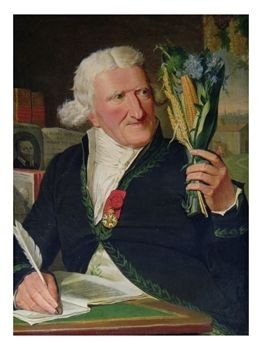
Antoine-Augustin Parmentier
When the mashed potatoes on the top turn a golden brown, grated parmesan cheese may be added, and then the dish, is ready to be served. Hachis parmentier was named after Antoine-Augustin Parmentier, who popularized potatoes in France in the middle of the 18th century and in so doing saved many peasants from starvation; the dish called Hachis parmentier was already on French restaurant menus by the 1850's.
In the UK, the British shepherd's pie and cottage pie will be made without the garlic and grilled cheese on top, and Worcester sauce will be added; apart from those small changes these dishes are the same. These two dishes appeared on British and British colonial menus only in the early 20th century and obviously came from France where Brits had enjoyed Hachis parmentier when they began visiting France in large numbers at the end of the 19th century. Like it or not shepherd's pie and cottage pie are French imports.
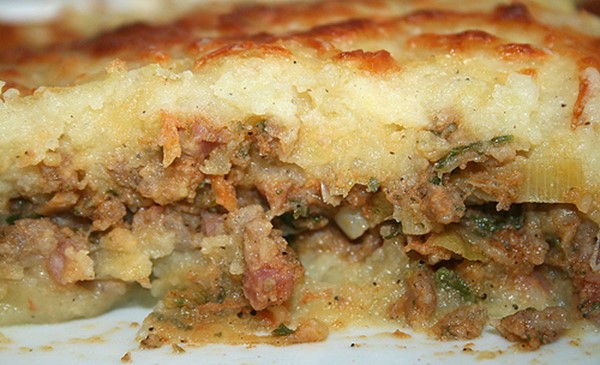
Hachis parmentier
Photograph courtesy of JaBB
The examples in this post show French contributions to traditional British dishes, and there are many others that could have been chosen.
Before closing, I will return to the subject of my own blog. While it is true that all English speakers can understand a French menu offering a Steak Frites or Steak Salade without a translation, even a basic French menu listing, such as a Darne de Saumon Grillée, Sauce Béarnaise, may confound the English speaking visitor who is not acquainted with French cuisine. At best a translation will read: "A thick cut of grilled salmon served with Sauce Béarnaise". A thick cut is clearly a darne, but how many English speakers, on their first visit to France, know what a Sauce Barnaise is? I enjoy, via my blog, sharing my knowledge, experiences and joy when dining on French cuisine. Today it is the English speakers who write books, articles, blogs, and create TV shows to explain French cuisine to English speakers. The French, with their historical connections to British cuisine, are urged to request the chefs and restauranteurs of France to make their menus more visitor-friendly.
Bryan Newman
Lecture supplémentaire :
Eating habits – The British at table
The Economist, July 27, 2013